A falcon named Frightful hit 242 mph in a 1999 dive from three miles up—faster than any other animal ever clocked on Earth.
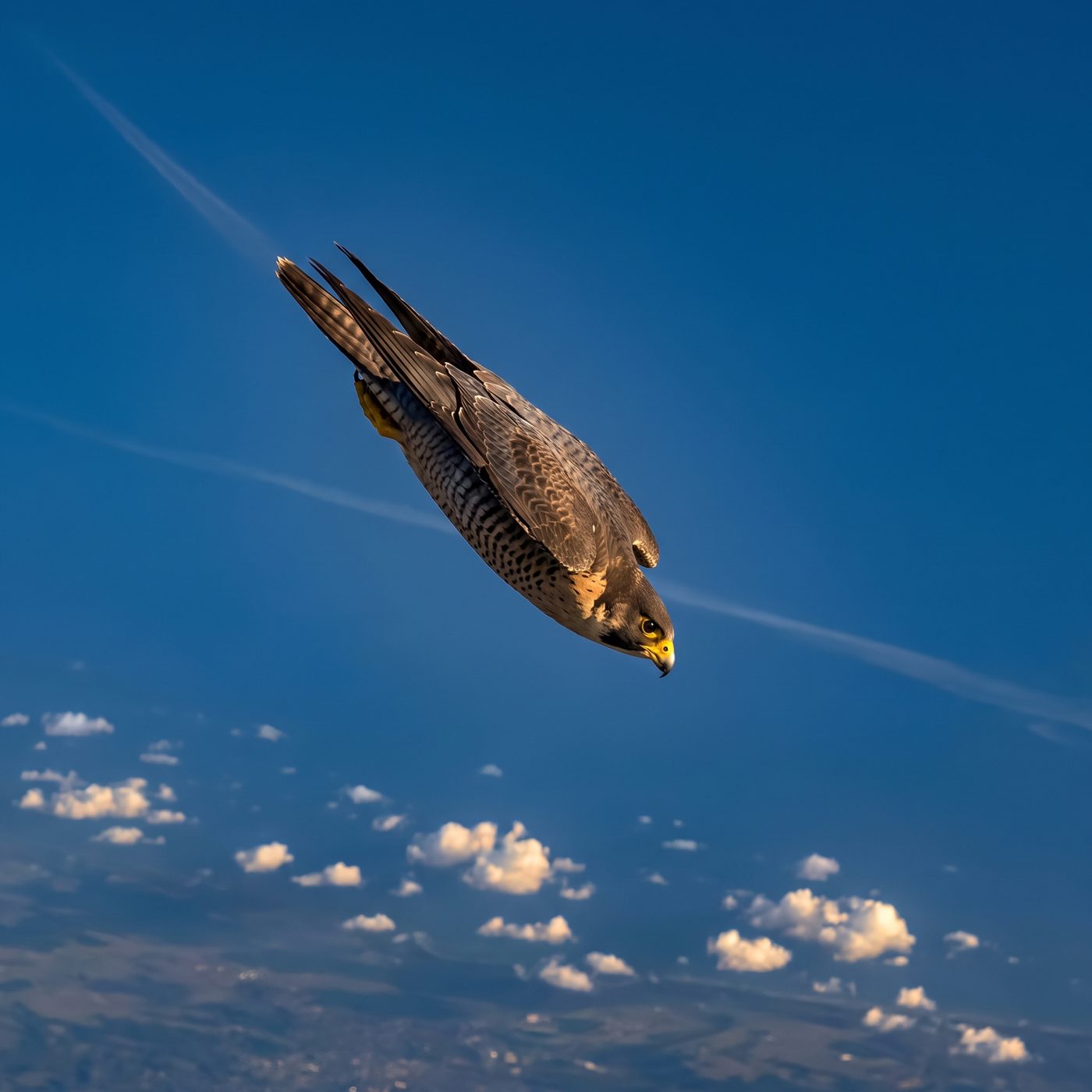 ILLUSTRATION · AI
In 1999, falconer Ken Franklin recorded his peregrine falcon Frightful diving at 242 mph, the fastest speed ever measured for any animal.
The number that made Frightful famous is 242 miles per hour—389.46 kilometers per hour—a diving speed no other animal on record has matched. Guinness World Records still lists it under "Fastest bird (diving)," and it belongs to a peregrine falcon owned and trained by Ken Franklin, a falconer from Friday Harbor, Washington. To reach it, both the bird and the man had to jump out of an airplane.
How Ken Franklin measured a falcon's dive
The trick to clocking a falcon isn't the falcon—it's the falconer keeping up with her. A peregrine's hunting dive, called a stoop, happens in seconds and covers thousands of feet, far faster than any ground-based observer can follow. Franklin's solution, as he described in a 2012 interview with Ari Daniel Shapiro for IEEE Spectrum and Living on Earth, was to give himself the same head start as the bird.
In a series of dives in 1999, Franklin released Frightful from a Cessna 172 at 17,000 feet—about three miles up—then jumped out after her. To measure her speed, he borrowed a page from skydiving instrumentation: he took a 113.4-gram (4-ounce) computer chip out of a skydiver's Pro-Track recording altimeter and fastened it to her tail feathers. The device logged how far she fell over a given time interval, turning that altitude change into a velocity. Smithsonian's *Air & Space* magazine, in its 2013 feature "Falling with the Falcon," independently confirmed the 242-mph figure, the Cessna 172 at 17,000 feet, and the tail-mounted recorder.
That number is a peak reading, not a sustained cruising speed—the fastest instant in an acrobatic dive rather than an average across the whole plunge. It's the kind of distinction that matters when you're comparing an animal to a highway.
Why a falcon can fall that fast
A peregrine in a stoop is doing something closer to controlled falling than flapping flight. It tucks its wings, drops its head, and lets gravity do most of the work, shaping its body into something that slices through air rather than fighting it. The bird's anatomy is built for exactly this: baffles in its nostrils are thought to manage the crushing airflow, and a transparent third eyelid keeps its vision clear while it plummets toward prey.
Frightful's dives from a plane were a deliberate exaggeration of a natural act. A wild peregrine doesn't start three miles up—but given enough altitude and a target, the same physics that let it snatch a pigeon in a canyon can push it past 200 miles per hour. Franklin trained Frightful to chase a lure he dropped, so she had a reason to fold up and commit rather than simply glide down after him.
The vivid part isn't the airplane; it's the choreography. A man and a bird leaping into the same column of sky, the falcon outrunning him almost immediately, and a repurposed skydiver's chip riding her tail feathers to write down the moment she overtook everything else alive.
What's still open to argue
Here's the seam. Frightful's 242 mph is a *measured* record made under staged, extreme conditions—a bird dropped from a plane far higher than any natural hunt begins. Field biologists tracking wild peregrines by radar have logged top hunting-stoop speeds closer to 389 kilometers per hour as well, but the methods differ enough that comparing them isn't clean. A tail-mounted altimeter, a radar gun, and a stopwatch don't measure the same thing in the same way.
So the honest answer to "how fast is the fastest animal?" depends on what you're willing to count. If you want the absolute peak ever recorded, it's Frightful. If you want what a falcon does when it's hunting for real, on its own terms, the ceiling may sit a little lower—and the argument over which figure deserves the crown is one the record books haven't fully settled.
- Tier 2 · Secondary2015
- Tier 2 · Secondary2013
More facts

In a 2015 wire-fraud trial, a judge let the defense argue the numbers were innocent using a 1938 law of how often digits start with 1.

In real-world data, the number 1 leads about 30% of the time—and the IRS uses that skew to flag faked tax returns as fraud.