A honeybee dancing 40° left of straight-up on the dark comb is telling her hive the food sits 40° left of the sun — a 1:1 angle swap.
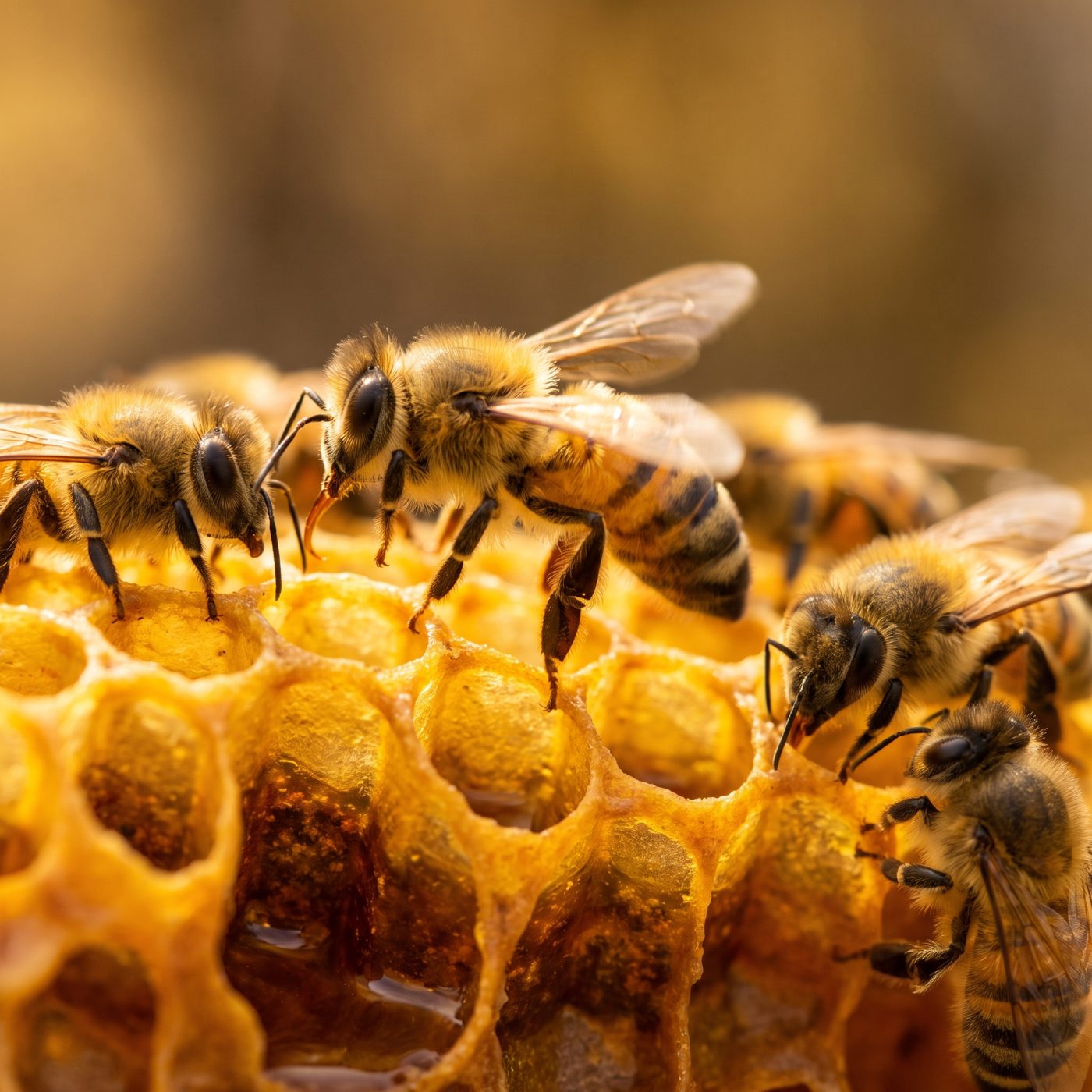 ILLUSTRATION · AI
On the dark vertical comb, a honeybee's waggle run at 40° left of straight-up tells her sisters the food lies 40° left of the sun — the same angle, swapped from sun to gravity.
A returning forager cannot point at a flower she found a quarter mile away. She's inside a lightless hive, on a wall of vertical comb, surrounded by bees who never saw her route. So she does something stranger and more elegant than pointing: she swaps one reference for another. The angle she flew relative to the sun becomes the angle she dances relative to gravity. Straight up on the comb stands in for the sun. A source 40° to the left of the sun's azimuth produces a waggle run tilted 40° to the left of straight-up — one angle, transposed nearly one to one.
That means a bee reading the dance in total darkness recovers a direction she can only fly toward once she's back outside in daylight. The dance is a set of instructions written in gravity, to be executed against the sun.
How Karl von Frisch cracked the code
The Austrian ethologist Karl von Frisch spent decades watching marked bees on observation hives, and he laid out the mechanism plainly in his 1973 Nobel lecture, "Decoding the Language of the Bee." On a horizontal comb, he found, a bee can dance the honest way — she runs her waggle straight at the food, "just as we show the way by raising an arm." But bees normally build vertical comb, and gravity, not sunlight, dominates in the dark. So the bee substitutes. She sets herself, von Frisch wrote, "at the same angle to the sun" she held in flight — except now that angle is measured against the downward pull of gravity instead. Up is sun. The tilt of the run carries the bearing.
The vivid part is what she does inside the run itself. During the straight "waggle" portion, she vibrates her body side to side while running forward, and the direction of that forward run — not the looping return — encodes the heading. Her nestmates crowd close, antennae reading the tremor, then leave the hive and fly the bearing.
Why the angle swap still holds up under machine eyes
Von Frisch's claim was bold enough to win a Nobel Prize in 1973, and bold claims invite testing. Modern researchers have checked it not with a stopwatch and a protractor but with computer vision. In 2017, Fernando Wario and colleagues, publishing in PLOS ONE, built a system to automatically detect and decode waggle dances from video. Their finding restated von Frisch in the language of measurement: "The average orientation of successive waggle runs with respect to gravity approximates the angle between the advertised resource and the solar azimuth as seen from the hive."
Note the honest words — "average" and "approximates." A single waggle run scatters; the message lives in the mean of several. Randolf Menzel, writing in the journal Insects in 2019, put the same relationship in cognitive terms: the flight direction relative to the sun's current azimuth "is given in the angle of the waggle phase relative to gravity on the vertical comb in the dark hive." And the bee biologist Thomas D. Seeley, writing for Bee Craft in 2025, kept the geometry front and center: bees indicate the food's angle relative to the sun "by pointing their waggle runs at the same angle relative to straight up on the comb."
What's still open to argue
The transposition is real, but "near 1:1" is doing quiet work. The sun moves — its azimuth sweeps across the sky through the day — so a bee dancing for an hour must gradually rotate her runs to keep the heading true, adjusting for a target she cannot see. And the receivers don't get a clean signal; they average noisy runs and still fly accurately, which raises a question von Frisch never fully closed: how much of the precision lives in the dancer's code, and how much in the follower's ability to read the mess and correct it. The angle swap is settled. Who does the math — dancer or audience — is still being argued.
More facts
Congress promised public broadcasting $9 million in 1967, then paid out only $5 million in 1968 — before Fred Rogers ever reached the Senate.

In 2019 Emma Haruka Iwao calculated pi to 31.4 trillion digits — a number so vast it took 170 terabytes to store, matching the Library of Congress.