Every wild Southern Resident killer whale on Earth was counted in July 2025. The total came to 74 animals, in three families.
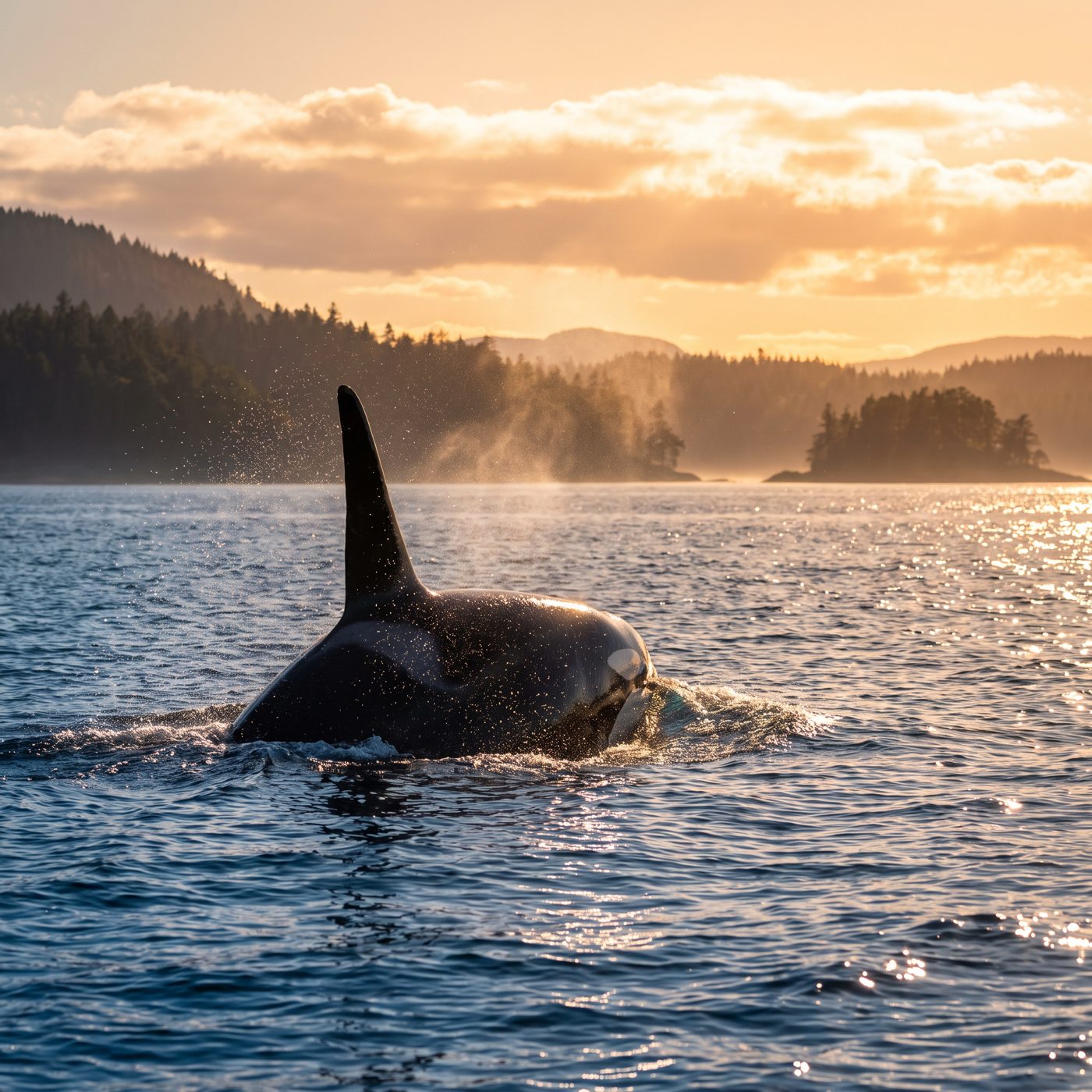 ILLUSTRATION · AI
NOAA Fisheries reports that the July 2025 census of the endangered Southern Resident killer whales counted 74 animals, against an estimated historical minimum of about 140.
You could count every wild Southern Resident killer whale on Earth in an afternoon. In July 2025, that is essentially what happened: the annual census counted 74 whales, spread across three extended families. NOAA Fisheries records the number plainly on its Killer Whale: Populations page, and the Marine Mammal Commission cites the same figure. The entire population would not fill a school bus.
Those three families are known by the letters J, K, and L. The Puget Sound Partnership, in its Indicator 32 tracking, breaks the 2025 count down family by family: 27 whales in J pod, 14 in K pod, and 33 in L pod. Each animal is individually identified and catalogued—these are not statistical estimates but named, photographed individuals, some of them tracked for decades.
Why so few Southern Resident killer whales are left
The census is led by the Center for Whale Research, whose photo-identification work NOAA relies on for the annual tally. The Anchorage Daily News, reporting on the latest count, put it simply: "Just 74 southern resident orcas remain."
To grasp how small that is, set it against the past. NOAA Fisheries estimates the minimum historical population size of Southern Residents was about 140 animals. That figure is itself a floor, not a peak—the low end of what the population is thought to have numbered before it was hollowed out. The live-capture era of the 1960s and early 1970s took dozens of these whales for marine parks, removing a generation of young animals. The population has never recovered.
Southern Residents are a distinct group, genetically and culturally separate from the other killer whales that share their coastal waters. They do not interbreed with the transient orcas that hunt seals and porpoises. They speak, in effect, a different dialect, and they eat a different diet—overwhelmingly Chinook salmon. That specialization is now a liability. As Chinook runs have collapsed across the Pacific Northwest, the whales that depend on them have followed.
How researchers count every whale
The method is patient and old-fashioned. Researchers photograph the saddle patch and dorsal fin of each whale—markings as distinctive as a fingerprint—and match them against a catalog maintained since the 1970s. A whale is presumed alive until it fails to appear alongside its family across repeated encounters. When a known individual goes missing, the count drops by one, and the loss is documented with a name and a life history.
That is why the number carries weight. It is not a sampling model or a population projection. It is a roll call. Ken Balcomb's Center for Whale Research began the annual survey decades ago, and the continuity of that record is what makes a figure like 74 meaningful rather than merely alarming.
The concrete detail that makes it land: L pod, the largest of the three families at 33 members, is still the biggest, yet it is a fraction of what it once was. Individual whales in these pods have been followed from birth—their calvings celebrated, their deaths recorded—so that the arithmetic of decline is measured one recognizable animal at a time.
What remains genuinely open is whether the trajectory can be reversed. The consensus among researchers points to three linked pressures: too little Chinook salmon, contaminants stored in the whales' fat, and noise and disturbance from vessel traffic that interferes with the echolocation they use to hunt. Which of these matters most—and whether removing dams, curbing pollution, or quieting the water would move the number back up—is still argued. The census settles the count. It does not settle the cure.
More facts

Congress promised public broadcasting $9 million in 1967, then paid out only $5 million in 1968 — before Fred Rogers ever reached the Senate.

In 2019 Emma Haruka Iwao calculated pi to 31.4 trillion digits — a number so vast it took 170 terabytes to store, matching the Library of Congress.