Greg Whipple mapped 400 acres of dying trees in Oregon in 1988. Genetic testing later proved it was ONE fungus spanning 2,385 acres.
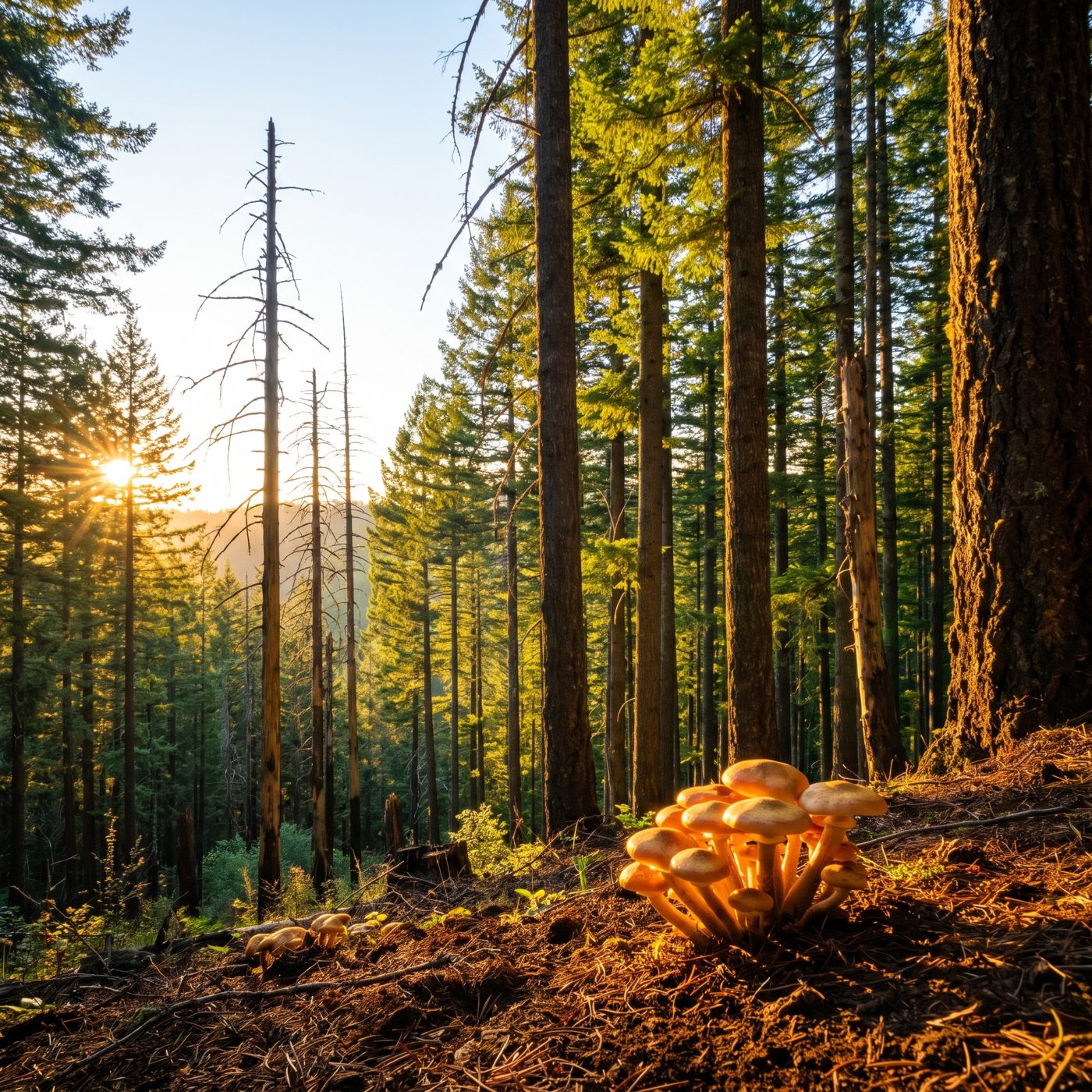 ILLUSTRATION · AI
A single Armillaria ostoyae fungus in Oregon's Malheur National Forest, first mapped at 400 acres in 1988, was later proven by genetic testing to be one organism spanning 2,385 acres.
In 1988, a Forest Service employee named Greg Whipple walked the Malheur National Forest in northeastern Oregon looking for the cause of a slow wave of tree death. He mapped what he could see and estimated the damage at about 400 acres. He had, in fact, found only a fraction of it. Later genetic work established that the killer was a single organism sprawling across 2,385 acres — nearly six times Whipple's first estimate, and one of the largest living things ever documented.
The culprit is *Armillaria ostoyae*, a honey fungus that lives mostly out of sight. What you notice above ground is the effect: clusters of pale mushrooms in autumn, and conifers dying in expanding patches. What you don't see is the network underground — sheets of fungal tissue pressed between bark and wood, and black, shoelace-like strands called rhizomorphs that creep through the soil from one root system to the next, spreading the infection tree by tree.
How scientists proved it was a single organism
Mapping dying trees can't tell you whether you're looking at one fungus or many. To answer that, researchers had to test whether tissue collected from far-apart trees belonged to the same individual. They used two methods. The first, somatic-incompatibility pairing, grows two fungal samples together in a dish: if they merge cleanly, they're the same genet; if a dark barrier forms where they meet, they're strangers. The second was DNA fingerprinting, which compares genetic markers directly.
The definitive account came from Brian Ferguson, Tina Dreisbach, Catherine Parks, Gregory Filip, and Craig Schmitt, publishing in the *Canadian Journal of Forest Research* in 2003. Surveying the mixed-conifer forest of the Blue Mountains, they identified five distinct *A. ostoyae* genets covering roughly 20, 95, 195, 260, and 965 hectares. That largest one — 965 hectares, or 2,385 acres — matched across every sample they tested. It was a single organism, and the mapped patch Whipple had reported in 1988 was just one corner of it.
The Oregon Encyclopedia, in Jim Scheppke's 2020 entry on the "Humongous Fungus," records the sequence plainly: Whipple was the first Forest Service employee to investigate the infestation, it appeared at first to cover 400 acres, and additional genetic research determined it was a single organism covering 2,385 acres. Oregon Public Broadcasting's *Oregon Field Guide*, reporting the same year, put the final figure in familiar terms — nearly three and a half square miles.
Here is the detail that makes the scale concrete. Nobody weighed this fungus, and nobody dug it up. It could not be picked up, boxed, or seen whole from any vantage point. Its unity exists only in the DNA — thousands of separate-looking mushrooms and root infections that all turned out to carry one genome, stitched together underground across a forest.
Why the "largest living thing" claim is still debated
Calling it the largest organism on Earth depends on how you count. By area, the Malheur genet is enormous. But "largest" invites arguments the fungus can't settle. Do you measure by footprint, by living mass, or by volume? Much of the fungus is diffuse threads and dead wood, not solid tissue, so its total living weight is genuinely uncertain and hard to compare against a giant sequoia or a stand of quaking aspen sharing one root system.
Age is contested, too. Estimates for how long the Oregon fungus has been growing run from a few centuries to several thousand years, extrapolated from how fast the disease front advances — a rate that varies with soil, moisture, and the trees it feeds on. Those are educated projections, not measured birthdays.
So the verified core holds: one fungus, 2,385 acres, confirmed by pairing tests and DNA. What remains open is everything the genome can't tell you — how heavy it is, how old, and whether "largest living thing" is a title or just a way of admitting we've never seen anything quite like it.
More facts

In a 2015 wire-fraud trial, a judge let the defense argue the numbers were innocent using a 1938 law of how often digits start with 1.
In real-world data, the number 1 leads about 30% of the time—and the IRS uses that skew to flag faked tax returns as fraud.