In 1964 a grad student cut down a bristlecone pine to study it—then counted 4,844 rings and realized he'd killed the oldest tree on Earth.
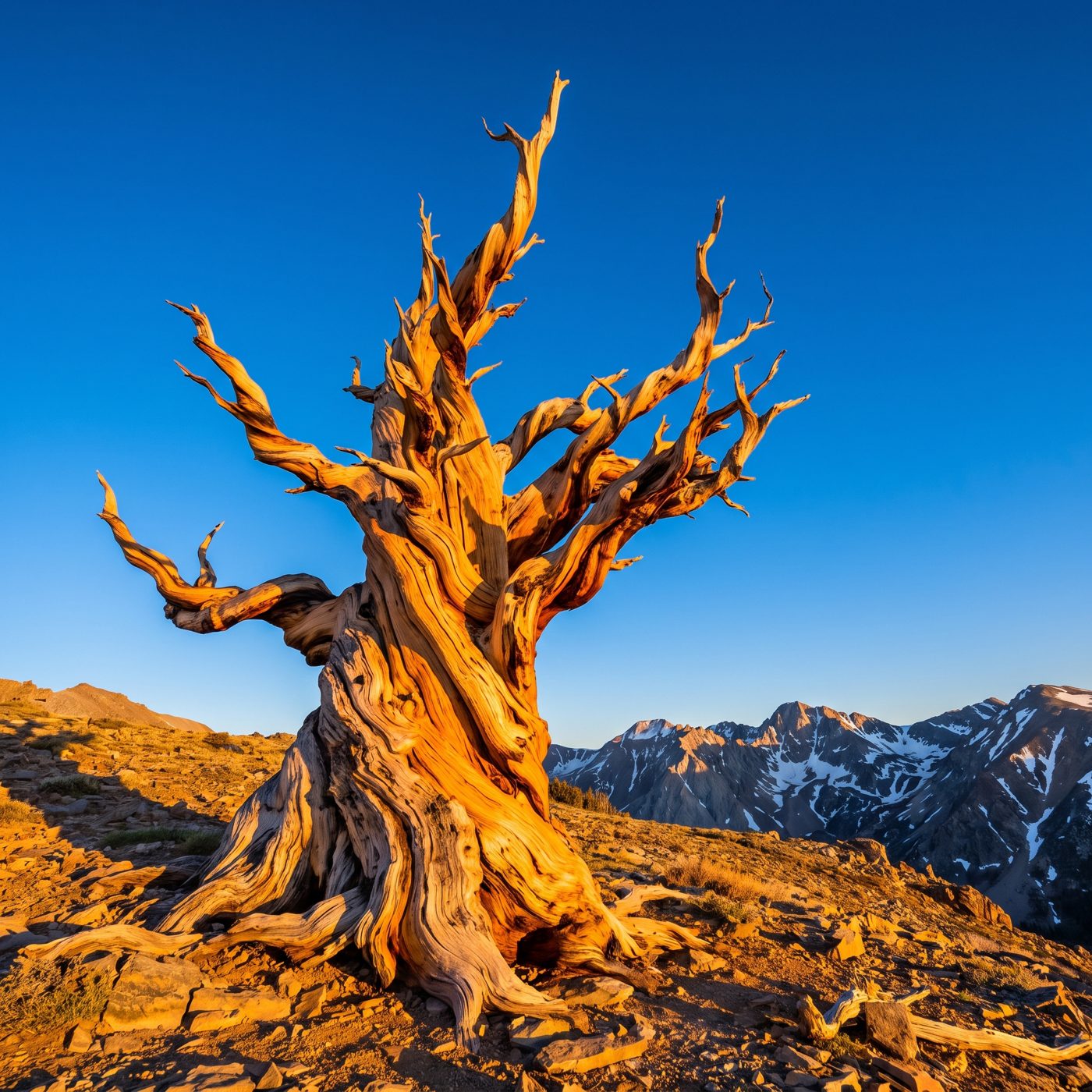 ILLUSTRATION · AI
In 1964, graduate student Donald R. Currey had a Nevada bristlecone pine cut down for research, then counted 4,844 rings and realized the tree had been alive for roughly 4,900 years—older than any tree then known.
The tree had no name when the saw went in. Foresters called it WPN-114, one of a stand of gnarled Great Basin bristlecone pines clinging to a rocky cirque below Wheeler Peak in eastern Nevada. Donald R. Currey, a graduate student studying the region's Ice Age climate, wanted its rings to reconstruct old glacial timelines. In 1964, with U.S. Forest Service permission, the tree was felled. Only afterward, counting the rings on the fresh cross-section, did Currey realize what had been standing there: a living thing that had begun growing about 4,900 years ago—older than California's Methuselah, then dated at 4,789 years.
How we know the tree was nearly 5,000 years old
Currey published the count himself. In his 1965 paper "An Ancient Bristlecone Pine Stand in Eastern Nevada," in the journal *Ecology* (Vol. 46, No. 4), he reported measuring 4,844 annual rings in the cross-section and estimated the tree "began growing about 4,900 years ago." That gap between the counted rings and the estimated age matters: bristlecones in harsh sites sometimes fail to lay down a full ring in a brutal year, so a raw count tends to run slightly younger than the true age. Later corrections for those missing rings pushed popular estimates higher—you'll see 4,862 and other figures repeated in the press and on Wikipedia—but Currey's own peer-reviewed number was 4,844 rings, roughly 4,900 years of life.
For context, Methuselah, the famous bristlecone in California's White Mountains, had been dated from core samples in 1957 to more than 4,800 years old. That tree is still alive; its exact location is kept secret to protect it. WPN-114 beat it—and it took cutting the tree open to find out.
Why a tree that old was cut down at all
The most common version of the story frames it as a stuck coring tool and a desperate improvisation. The plainer record, laid out by *Smithsonian* magazine in 2024, is that Currey had Forest Service permission to fell the tree, that a crew spent roughly a week working through the dense, resin-hard wood, and that the age was only determined afterward, once he sat down to count. This was not vandalism. It was sanctioned research that produced a result nobody had braced for.
Guinness World Records, which lists the Great Basin bristlecone as the oldest living tree species, states the tree was "over 4,900 years old when it was controversially cut down in 1964 by Donald Rusk Currey." The nickname came later. Someone dubbed the dead giant Prometheus, after the Titan who stole fire and was punished for it—an unusually pointed piece of naming for a stump.
The concrete detail that lingers is the wood itself. Bristlecone pine in these sites grows so slowly, and so densely, that its rings can be almost microscopically thin—thousands of years packed into a trunk you could reach around. Currey didn't glance at the cross-section and see millennia. He had to count, ring by ring, for days, before the number 4,844 came into focus and the enormity of it landed.
The felling of Prometheus is often credited with hardening protections for the oldest bristlecones and helping motivate the creation of Great Basin National Park in 1986. What remains genuinely open to argument is the age itself. Currey's counted 4,844 is a floor, not a ceiling; the "true" figure depends on how many rings the tree quietly skipped over five millennia of drought and cold, and those corrections are estimates, not counts. We know almost exactly how old the tree was when it died. We will never know precisely, because the only way to check was to end it.
More facts

In a 2015 wire-fraud trial, a judge let the defense argue the numbers were innocent using a 1938 law of how often digits start with 1.

In real-world data, the number 1 leads about 30% of the time—and the IRS uses that skew to flag faked tax returns as fraud.