In 1994 Hubble weighed M87's black hole at 2.4 billion Suns. In 2019 a photo of its shadow said 6.5 billion — 2.7 times heavier.
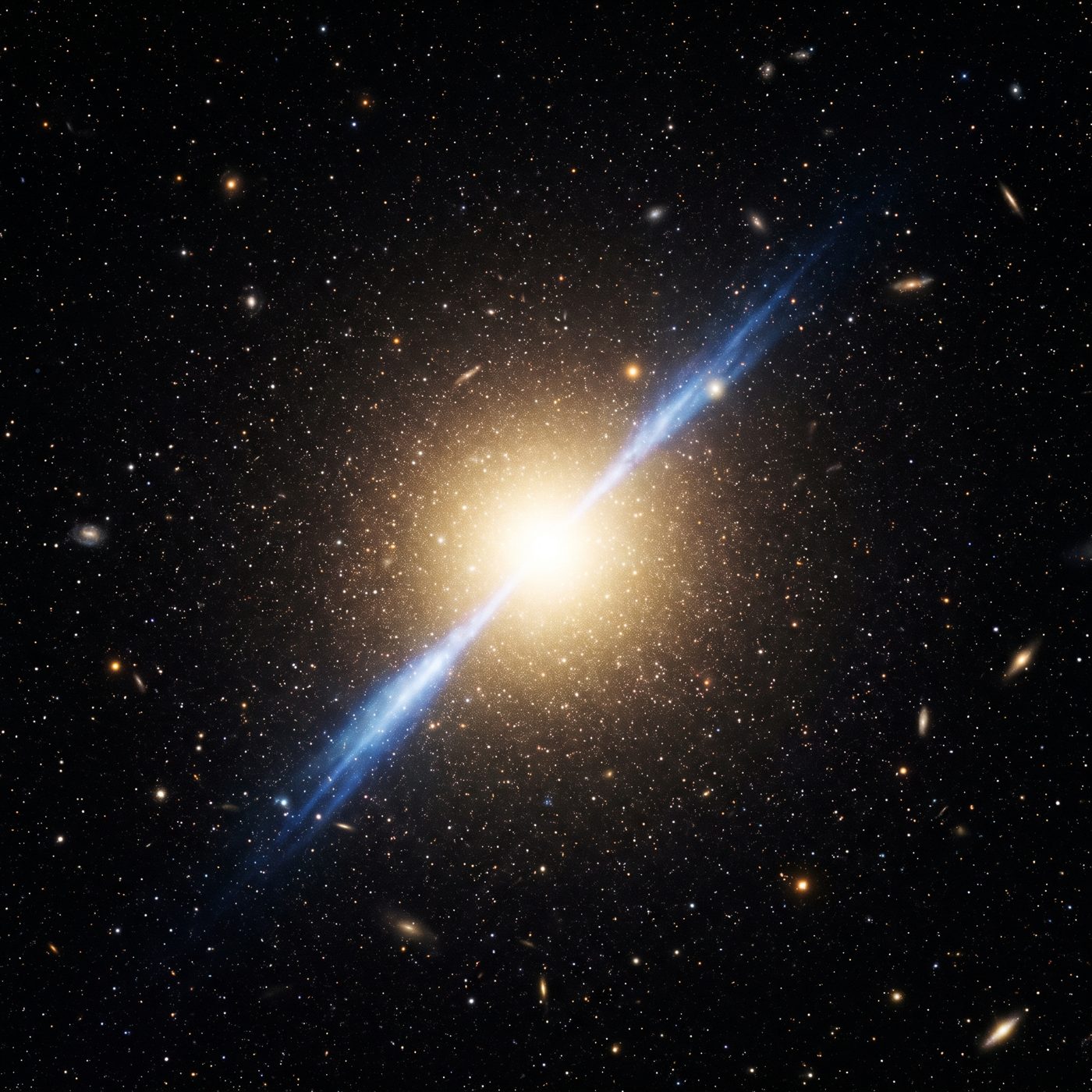 ILLUSTRATION · AI
The Hubble telescope's 1994 measurement of M87's central black hole put it at 2.4 billion solar masses; the Event Horizon Telescope's 2019 image of the black hole's shadow put it at 6.5 billion — 2.7 times heavier, from a completely different method.
Same black hole. Same galaxy, the giant elliptical M87 sitting some 55 million light-years away in the Virgo cluster. Two measurements, twenty-five years apart, and the second one is nearly triple the first. In 1994 the Hubble Space Telescope weighed the central object at (2.4 ± 0.7) billion Suns. In 2019 the Event Horizon Telescope, working from the now-famous orange ring, put the same mass at (6.5 ± 0.7) billion. That is not a rounding error. It is one of the cleaner illustrations in astronomy of how much your answer depends on how you ask the question.
The 1994 number came from Richard Harms and colleagues using Hubble's Faint Object Spectrograph. Their method was gas dynamics: point the instrument at the whirling disk of ionized gas near M87's center and measure how fast it moves. Gas on one side rushes toward you, gas on the other side rushes away, and the Doppler shift in the light tells you the orbital speed. Faster orbits mean more mass pulling the gas around. Harms's team clocked those velocities and back-solved for the mass hidden at the center — (2.4 ± 0.7) × 10⁹ solar masses. That figure is still cited today, including by Anna Walsh and collaborators in their 2013 Astrophysical Journal reanalysis and by Simon and colleagues in a 2023 Monthly Notices paper that lists both the old and new values side by side.
Why the two measurements disagree
The gas-dynamics method has a known weakness: the gas near a black hole is turbulent, buffeted by jets and radiation pressure, and it doesn't always move on tidy circular orbits. If some of the gas velocity you measure comes from anything other than pure gravitational orbiting — or if the disk is tilted in a way you've misjudged — your mass estimate drifts. Over the decades, stellar-dynamics measurements (tracking the motions of whole stars instead of gas) tended to land higher than the gas numbers, hinting the 1994 value was on the low side.
The Event Horizon Telescope sidestepped the gas entirely. Instead of inferring the mass from orbiting material, the collaboration measured the size of the black hole's shadow directly. When the EHT team published their first M87 results in the Astrophysical Journal Letters in April 2019, they reported a shadow whose diameter, given general relativity, corresponds to (6.5 ± 0.7) billion solar masses — the figure AAS Nova and later papers repeated. The shadow's angular size is set almost entirely by the mass and the distance, with very little else to muddy it.
How you photograph a shadow the size of Earth's telescope
To resolve a ring that small on the sky, the EHT linked radio dishes from Hawaii to Spain to the South Pole into a single virtual instrument the size of the planet — a technique called very-long-baseline interferometry. Each dish recorded the incoming radio waves against an atomic clock, and the data were shipped on physical hard drives to be combined later, because no internet connection could carry that flood of bits. The resulting resolution was fine enough to make out an orange donut of light bending around a void 55 million light-years away.
So which number is right? The consensus has moved toward the heavier EHT value, and stellar-dynamics work had already been pointing that direction. But the interesting seam is not that one method beat another. It's that both were measuring the same object honestly, and the gap between 2.4 and 6.5 billion Suns is a record of everything the gas near a black hole hides from us — turbulence, geometry, the assumption that whatever swirls also orbits cleanly. The shadow doesn't lie about those things. The gas, it turns out, quietly did.
More facts

In a 2015 wire-fraud trial, a judge let the defense argue the numbers were innocent using a 1938 law of how often digits start with 1.

In real-world data, the number 1 leads about 30% of the time—and the IRS uses that skew to flag faked tax returns as fraud.