On December 24, 2024, NASA's Parker Solar Probe hit 430,000 mph — fast enough to fly from New York to Tokyo in under a minute.
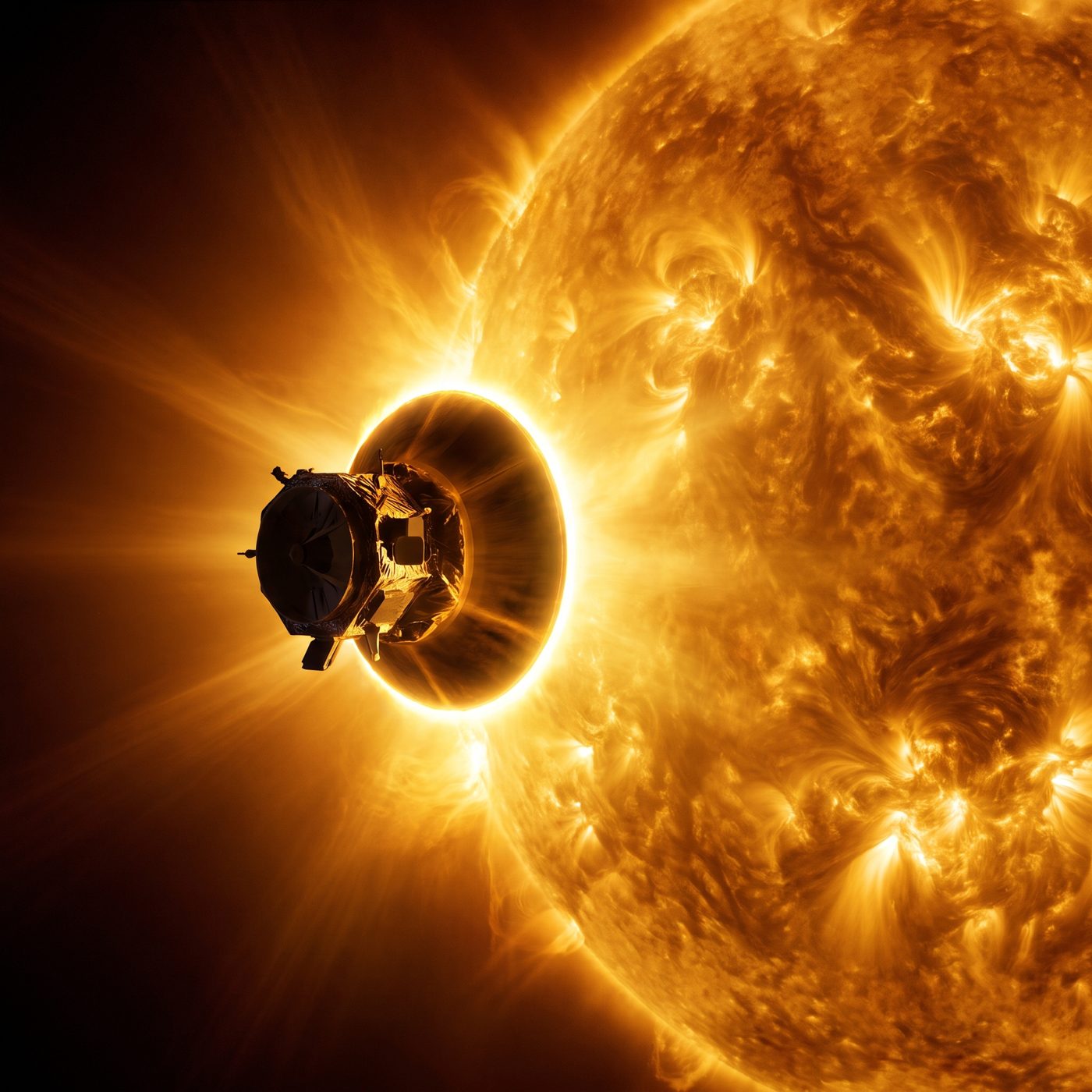 ILLUSTRATION · AI
On December 24, 2024, NASA's Parker Solar Probe reached 192.22 km/s — about 430,000 mph — as it swung within 6.17 million kilometers of the Sun's surface, the fastest speed any human-made object has ever traveled.
At 11:53:48 UTC on Christmas Eve 2024, a car-sized spacecraft became the fastest thing humanity has ever built. NASA's Parker Solar Probe hit 192.22 kilometers per second — 692,000 km/h, or roughly 430,000 mph — as it grazed the outer atmosphere of the Sun. Guinness World Records logged the moment to the second, listing it as the "Fastest spacecraft speed" on record.
To put the number in a human frame: at 192 kilometers every second, you could cross the roughly 10,800 kilometers between New York and Tokyo in under a minute. Nothing people have launched has moved faster.
How the Parker Solar Probe got so fast
The speed isn't the point of the mission — it's a side effect of getting close to the Sun. Parker, built and operated by the Johns Hopkins University Applied Physics Laboratory, spent years using flybys of Venus to shrink its orbit, letting the planet's gravity bend and tighten its loop around the Sun with each pass.
The physics that follows is the same that governs a comet or a dropped stone. As an object falls closer to a massive body, it trades altitude for velocity. Parker's December 24 pass brought it within 6,167,590 kilometers of the Sun's surface — about 6.17 million kilometers, or in NASA Science's rounding, 3.8 million miles. At the bottom of that dive, gravity had accelerated the spacecraft to its peak. Perihelion, the closest point, and top speed arrive at the same instant, which is why Guinness's timestamp marks both.
Surviving that neighborhood is its own feat. The Sun-facing side of Parker's heat shield endures temperatures approaching 1,000 degrees Celsius, while the instruments tucked behind it stay near room temperature — a carbon-composite shell doing the work of a parasol at a distance where sunlight is hundreds of times more intense than at Earth.
How we know the number is real
The figure isn't an estimate from a telescope watching from afar. It comes from the mission's own telemetry — the spacecraft's tracked position and velocity, reconstructed by the navigation team at Johns Hopkins APL and NASA. Both institutions announced the record pass, with APL and NASA Science each citing the same 692,000 km/h / 430,000 mph speed and the roughly 6.1-million-kilometer approach on December 24, 2024.
Guinness World Records then verified those values independently for its "Fastest spacecraft speed" listing, publishing the precise figures — 192.22 km/s, the 11:53:48 UTC timestamp, and the 6,167,590-kilometer distance — that match the mission data to the decimal. When a claim can be checked against telemetry from the object itself, there's little room for exaggeration; the spacecraft essentially reports its own speed.
The vivid part is how routine this had become for Parker by then. This was one of several planned close passes at the same record distance and speed, part of a mission designed from the start to repeatedly break its own record. Speed that would have been unthinkable a generation ago became the spacecraft's cruising configuration for a few hours each orbit.
What's still open to argue
Parker's record is a record for *human-made* objects, and that qualifier is where the interesting arguments live. Natural objects routinely move faster — sungrazing comets that plunge even closer to the Sun can exceed these speeds, and material ejected in cosmic events moves at fractions of light speed. Parker is only the fastest thing *we* have made.
And it may not hold the title forever against ourselves. The same gravity-assist logic that got Parker here could, in principle, be pushed further, and proposed missions to skim even closer to the Sun or to use solar sails and other propulsion have been sketched on paper for decades. For now, though, the fastest object ever to leave human hands is a probe roughly the size of a small car, and it set the mark on Christmas Eve.
More facts

Congress promised public broadcasting $9 million in 1967, then paid out only $5 million in 1968 — before Fred Rogers ever reached the Senate.

In 2019 Emma Haruka Iwao calculated pi to 31.4 trillion digits — a number so vast it took 170 terabytes to store, matching the Library of Congress.