Oxford carbon-dated three pages of one Indian math manuscript and got three answers 600 years apart: 224–383, 680–779, and 885–993 CE.
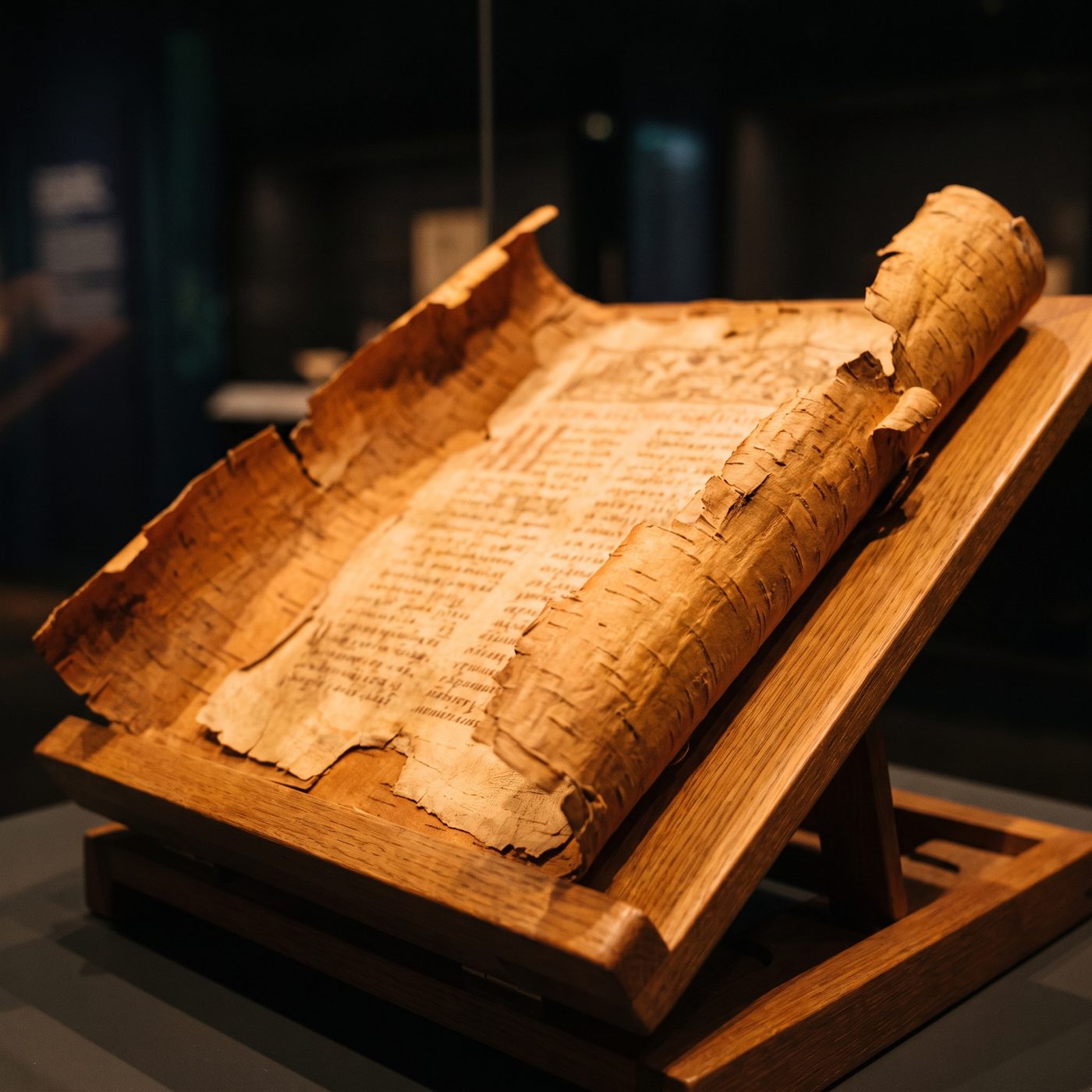 ILLUSTRATION · AI
When Oxford radiocarbon-dated three birch-bark leaves of the same Indian mathematical manuscript in 2017, the results landed roughly 600 years apart — suggesting the book was assembled from pages written in different centuries.
In September 2017, the Bodleian Libraries at the University of Oxford announced radiocarbon results for the Bakhshali manuscript, a fragile bundle of 70 birch-bark folios that has been in the library's care since 1902. Three folios were tested. Folio 16 came back to 224–383 CE. Folio 17 landed at 680–779 CE. Folio 33 fell to 885–993 CE. Three pages from one book, three answers separated by as much as six centuries.
That spread is the whole story. If the leaves were all cut and inscribed in a single sitting, their birch bark should date to roughly the same window. Instead the dates scatter, which is why the Bodleian's own announcement described the manuscript as composed of material "from at least three different periods." The book you can see today, in other words, may be a composite — older and newer leaves bound together at some later point.
Why the Bakhshali manuscript matters
The manuscript is a working document, a kind of arithmetical handbook, unearthed in 1881 near the village of Bakhshali, in what is now Pakistan. Its fame rests on a small mark: a solid dot used as a placeholder, the ancestor of the symbol we now write as zero. The Bodleian's press office framed the 2017 dating as evidence for the "oldest recorded origins of the symbol zero," a claim that traveled fast because it attached a hard laboratory date to one of the more consequential ideas in the history of counting.
The concrete detail worth holding onto is that dot. On these leaves it sits inside numerals as a spacer, marking an empty column — not yet the full-blown mathematical zero that behaves as a number in its own right, but the crucial first step toward it.
How we know — and why the dating is contested
The three ranges are not in dispute. They were confirmed and republished in a peer-reviewed paper by Dominik Wujastyk, Takao Hayashi, Agathe Keller, Clemency Montelle, and Kim Plofker, titled "The Bakhshālī Manuscript: A Response to the Bodleian Library's Radiocarbon Dating," in *History of Science in South Asia* in 2017. What those scholars disputed was the interpretation. Radiocarbon dates the birch bark — when the tree died — not the moment someone wrote on it. And on scribal, linguistic, and mathematical grounds, they argued, the text itself reads as a coherent composition, not a patchwork stitched from three eras. Bark can be stored, reused, or recycled; a single scribe could easily have written on leaves of varying age.
So the fact and its meaning pulled apart. The lab numbers were solid; the leap from "this bark is old" to "the oldest zero is this old" was the part specialists refused to grant.
The seam widened in October 2024, when Oxford's own conservation scientists — David Chivall, Victoria Lladó-Buisán, David Howell, and Gillian Evison — published a fuller study, "Radiocarbon dating of the Bakhshālī manuscript," testing folios 15, 16, 23, 33, and 55. Their revised result placed the manuscript at 799–1102 CE, superseding the 2017 figures. The dramatic six-century spread narrowed considerably, and the whole book slid later in time.
That revision does not erase the original episode; it clarifies what a headline number can and cannot carry. The 2017 dates were real measurements, honestly reported. The argument was never about the carbon. It was about what a dead tree can tell you about a living idea — and on that question, the manuscript is still being read.
More facts
In a 2015 wire-fraud trial, a judge let the defense argue the numbers were innocent using a 1938 law of how often digits start with 1.

In real-world data, the number 1 leads about 30% of the time—and the IRS uses that skew to flag faked tax returns as fraud.