Roman piers in the Bay of Naples are stronger now than the day they were poured — seawater reacts with the volcanic ash inside and grows crystals that knit the cracks shut.
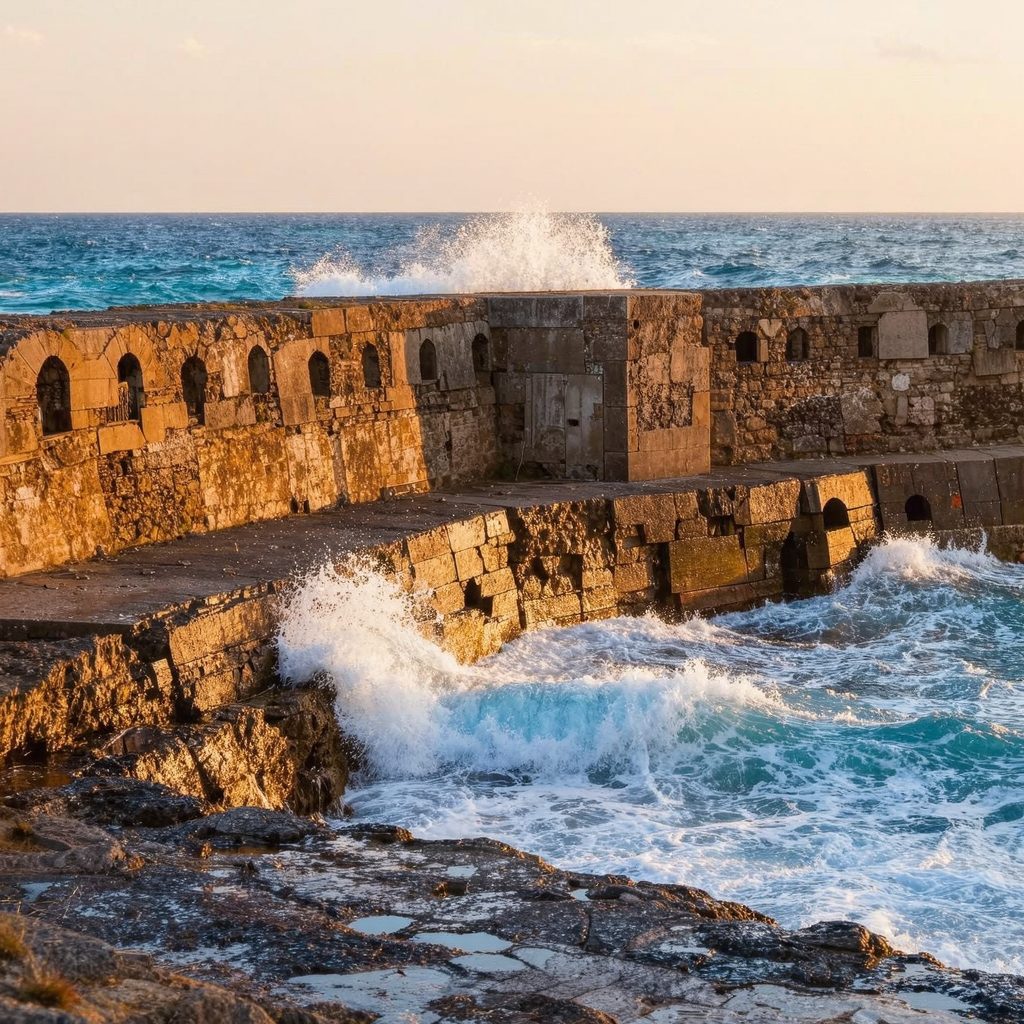 ILLUSTRATION · AI
Roman marine concrete has spent two thousand years underwater growing new crystals in its own cracks — a self-healing chemistry modern engineers are still trying to copy.
Walk out along the ancient piers and breakwaters ringing the Bay of Naples and you are standing on some of the most durable construction material ever made. The concrete the Romans poured into that seawater has not merely survived twenty centuries of waves and storms — by several measures it is tougher today than it was when the last worker smoothed it into place. The seawater that should have destroyed it has instead been rebuilding it from the inside.
The reason is a reaction the Romans set in motion without fully understanding it. Their mortar mixed lime with volcanic ash from the region around Pozzuoli — the material we still call pozzolana. When cracks opened in the hardened concrete and seawater seeped in, the water dissolved components of that ash and left new minerals behind in the gaps. The concrete keeps mending its own fractures, cementing them shut with crystals grown on site.
How the crystals knit the cracks shut
In 2017, a team led by Marie Jackson at the University of Utah put samples of Roman marine concrete under X-ray microdiffraction and electron microscopy and identified exactly what was filling the cracks. Two minerals stood out: aluminous tobermorite, a rare layered silicate, and phillipsite, a zeolite. Writing in American Mineralogist, Jackson and her colleagues showed these crystals had formed through low-temperature reactions between the seawater and the volcanic rock — the very percolation of saltwater that ruins modern concrete was, here, the engine of its strength.
The vivid part is where the crystals grow. Jackson's team found the platy tobermorite lacing through the interfacial zones and threading into the tiny fissures, interlocking like reinforcement laid down atom by atom. Each crack became a scaffold for new mineral growth rather than a weakness waiting to spread. Where our steel-reinforced concrete cracks, corrodes, and crumbles within decades, the Roman material treated damage as an opportunity.
Why modern concrete can't do this yet
A second piece of the puzzle came in 2023, when Linda Seymour, Admir Masic, and colleagues at MIT reported in Science Advances that the Romans may have used a technique they call hot mixing. The bright white lumps scattered through ancient concrete — long dismissed as sloppy mixing — turned out to be reactive calcium deposits. When a crack forms and water reaches one, the team argued, it releases calcium that recrystallizes and seals the fracture, giving the concrete a built-in first-aid kit.
There is a catch that keeps this from being a drop-in solution. Roman durability depends on a specific volcanic ash, on seawater, and on chemistry that plays out across centuries, not the years a modern construction schedule allows. Whether these mechanisms can be engineered to run fast enough, and at scale, for today's ports and seawalls is exactly what Masic and others are now testing.
For now the argument still runs both ways. The piers at Baiae and Portus are a proof of concept in stone — evidence that concrete can improve with age instead of decaying. The open question is whether we were meant to learn a recipe or a philosophy: copy the Roman chemistry, or copy their patience.
More facts

NASA's space shuttles flew 135 missions in 30 years, from the first launch on April 12, 1981, to the final landing on July 21, 2011.

NASA's Vehicle Assembly Building is 525 feet tall. Its high bay doors are 456 feet high and take about 45 minutes to open or close completely.