Saturn and Jupiter traded the title of 'most moons' three times in four years, ending with Saturn's 145 in May 2023.
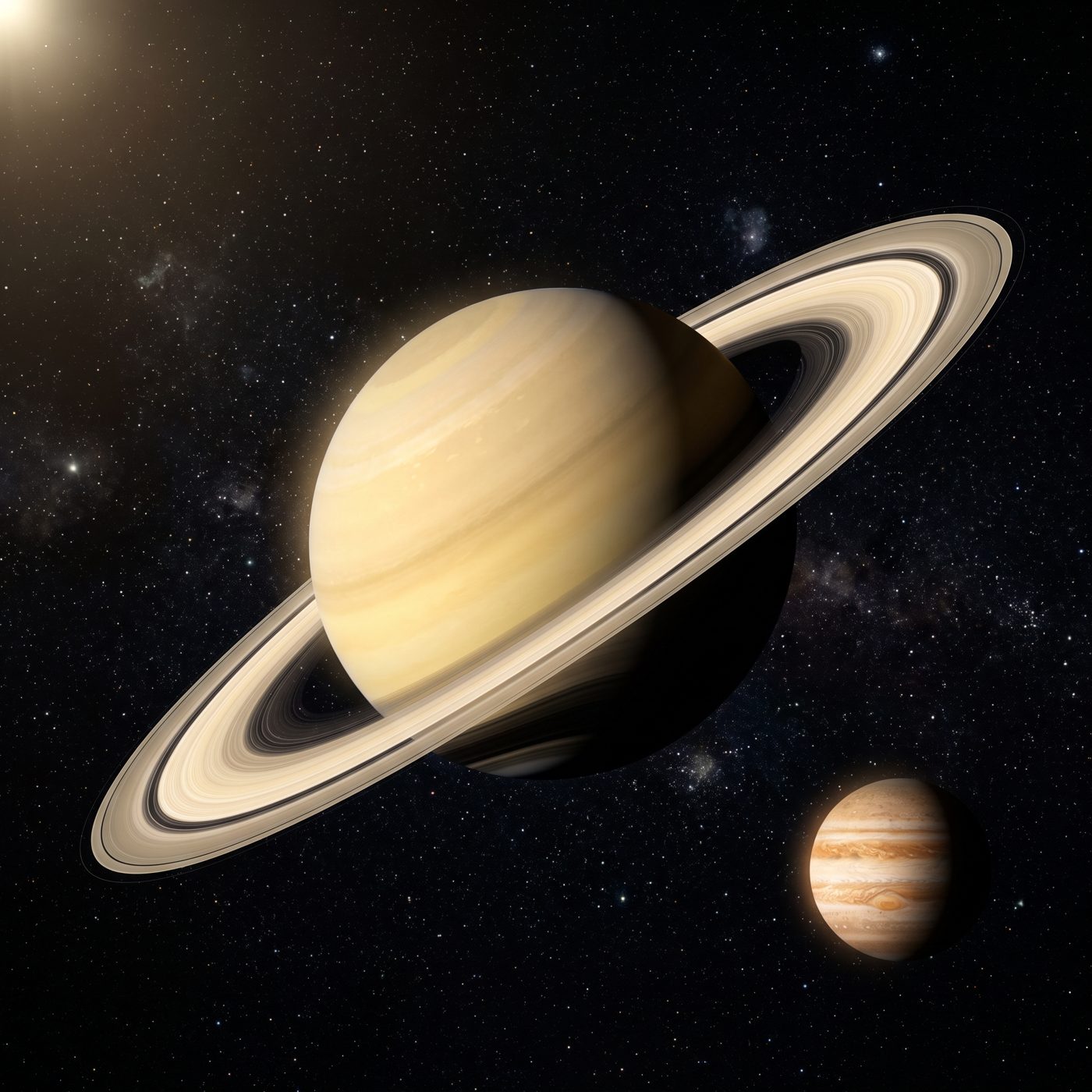 ILLUSTRATION · AI
Between 2019 and 2023, Saturn and Jupiter swapped the record for "planet with the most moons" three separate times, with Saturn pulling decisively ahead at 145 in May 2023.
If you want the ending first: Saturn holds the title, and it isn't close. In May 2023, the International Astronomical Union recognized 62 new Saturnian moons at once, pushing the planet's confirmed count to 145 and making Saturn the first world in our solar system with more than 100 moons. Jupiter, at 95, was left behind. But getting to that lopsided finish took three lead changes in four years.
How Saturn and Jupiter kept trading the record
The first flip came in October 2019. A team led by Scott Sheppard of the Carnegie Institution for Science, using the Subaru Telescope on Mauna Kea, announced 20 new moons around Saturn. That brought Saturn's total to 82, edging past Jupiter's 79. The Subaru Telescope and NAOJ published the discovery on October 7, 2019, and for the first time in years the ringed planet, not the gas giant, wore the crown.
Jupiter took it back. On February 3, 2023, the Associated Press reported (carried by PBS NewsHour) that astronomers had confirmed 12 additional Jovian moons, jumping Jupiter's total to 92. Saturn, sitting at 83, dropped to second. The lead had changed a second time.
Then came the rout. Just months later, in May 2023, the IAU's Minor Planet Center recognized 62 newly confirmed moons of Saturn in a single stroke. Sky & Telescope reported that the haul more than doubled the known population of Saturn's irregular moons—the small, distant, often retrograde bodies that likely represent captured debris rather than moons born alongside the planet. The Subaru Telescope marked the milestone by noting it had discovered Saturn's 100th moon in the process. Saturn's total reached 145, and the "moon king" title was Saturn's again.
Why the count keeps changing
The lead flipped so easily because these aren't the moons most people picture. Titan and Ganymede are giants you could resolve in a decent telescope. The moons driving these record swings are tiny—many just a few kilometers across—faint smudges detected only by stacking many long exposures and watching for points of light that drift with the planet across the sky over months. Confirming one means tracking it long enough to nail down its orbit, then submitting the observations to the Minor Planet Center, which issues the official designation. That's why a discovery made with 2019-era data could be "announced" years later: the confirmation, not the sighting, is what counts.
The vivid part is how these little moons behave. Most of Saturn's newly recognized objects orbit backward relative to the planet's spin and travel in tilted, elongated loops. Astronomers group them into families—clusters that share orbital paths and probably formed when a single captured moon shattered in a collision, scattering fragments that still travel together. Each fragment large enough to spot is now, by the working definition, a moon.
And that working definition is the seam still open to argument. There is no officially agreed lower size limit for what counts as a moon. A one-kilometer chunk of rock and a 5,000-kilometer world like Titan both get the same designation. When 62 fragments can be added in a single announcement, the "record" starts to feel less like a fact about the planet and more like a fact about survey sensitivity—about which telescope pointed where, for how long. Sky & Telescope even noted a 146th, S/2006 S 20, announced on May 22, 2023, an extra body that shows how fluid the tally really is.
So Saturn is the moon king, verifiably, at 145 confirmed and counting. But the count is a moving target, and the deeper question—what should count as a moon at all—remains unsettled. Every future survey that stares longer and fainter will only make that question louder.
More facts

In a 2015 wire-fraud trial, a judge let the defense argue the numbers were innocent using a 1938 law of how often digits start with 1.

In real-world data, the number 1 leads about 30% of the time—and the IRS uses that skew to flag faked tax returns as fraud.