The famous "September 3, 1928" date for penicillin's discovery appears in no document from 1928 — Fleming's first notebook mention is dated October 30.
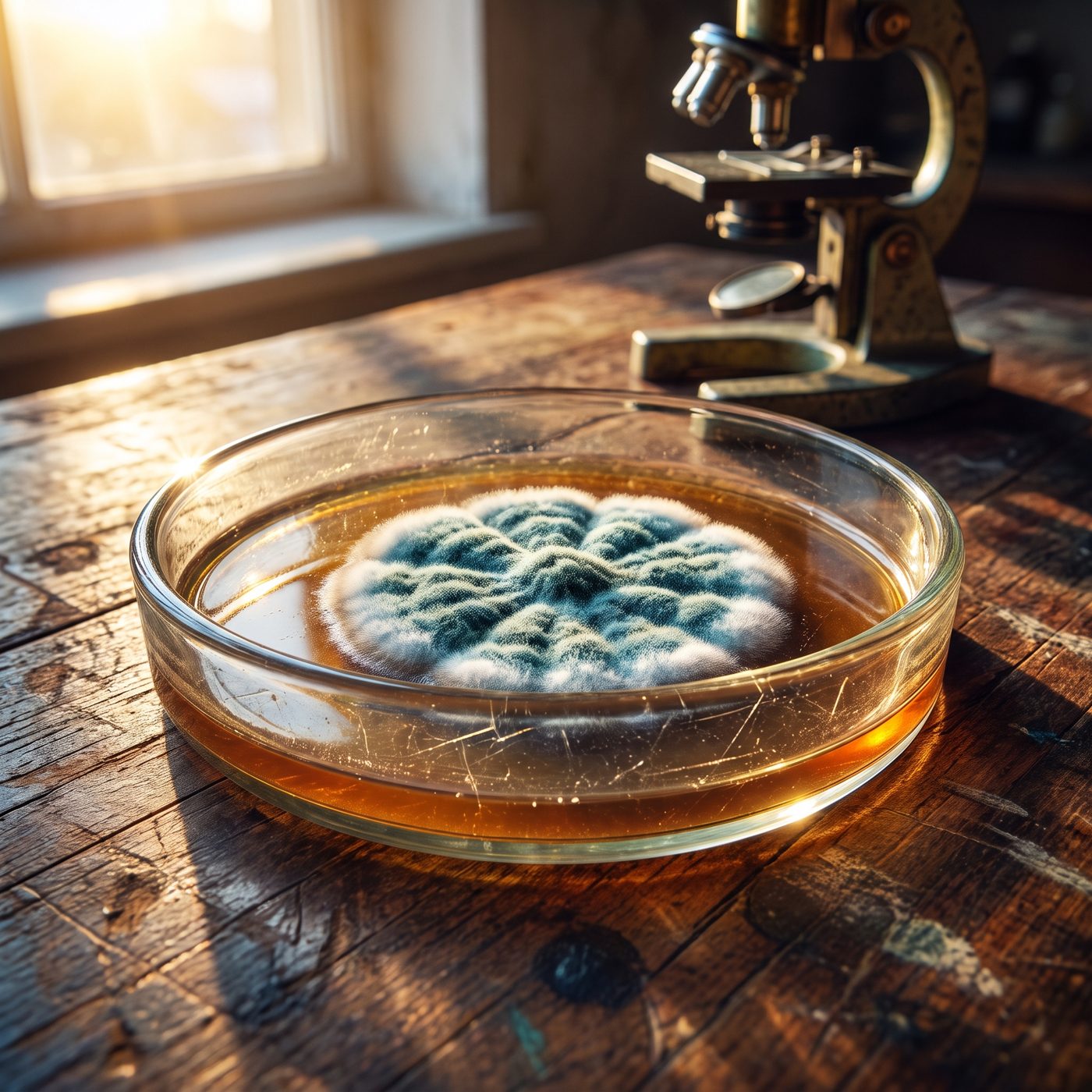 ILLUSTRATION · AI
The "September 3, 1928" date every textbook gives for penicillin's discovery appears in no document from 1928 — Fleming's own first notebook mention of the mould is dated October 30.
Look up the discovery of penicillin and you will find a precise date, repeated with the confidence of a birthday: Alexander Fleming returned from a summer holiday to his cluttered lab at St Mary's Hospital in London and noticed, on September 3, 1928, that a stray mold had killed the bacteria around it. It is a good story. It is also missing its most basic piece of evidence. No document written in 1928 records that day. The earliest dated entry in Fleming's lab notebook that mentions the mold and penicillin is an experiment dated October 30, 1928 — nearly two months after the finding is supposed to have happened, a gap noted by Asimov Press in its 2025 account "The Penicillin Myth."
Why the September 3 date is a reconstruction, not a record
The famous date does not come from a contemporaneous page. It comes from Fleming's own later recollections — accounts he gave in the years and decades afterward, which the Science History Institute, in its biography of Fleming, describes bluntly: his laboratory notebooks are sketchy, and his subsequent tellings of the discovery are contradictory. A man reconstructing his most important morning from memory is not a primary source in the way a dated notebook is.
The most careful attempt to pin the moment down was made by the bacteriologist Ronald Hare, who had actually worked alongside Fleming. In his 1982 paper "New Light on the History of Penicillin" in the journal Medical History, Hare tried to rebuild the timeline from the surviving notebooks combined with an unusual outside witness: Met Office weather records. The idea was that the mold needed a specific run of temperatures to grow before the bacteria were killed, so the London weather of that summer could constrain when the plate must have been left out. It was clever detective work — but it produced a plausible window, not a documented day. The contemporary paperwork simply does not fix an exact date.
So where does "September 3" actually gain its authority? Largely from a 2000 review by David Wilson in the British Journal of Biomedical Science, pointedly titled "The discovery of penicillin: so many get it wrong." Wilson argued the discovery occurred in September 1928, most likely on Monday, September 3, when Fleming came back from holiday in Suffolk. Note the phrasing: *most likely.* The best modern scholarship treats September 3 as the probable date, reasoned back from a return-from-vacation and a growth timeline — not as a fact anyone wrote down at the time.
How we know the gap is real
The concrete detail that anchors all of this is that October 30 notebook entry. It is real, dated, and held in the Fleming archive at St Mary's, and it is the first time Fleming's own hand connects the mold to what he would name penicillin. Everything earlier — the exact morning, the exact plate, the exact glance — lives in memory and in later retelling, not in ink from the season it happened.
This does not mean the story is false. Fleming did notice a contaminant mold that suppressed staphylococci; he did pursue it; the substance did become the twentieth century's great drug. The point is narrower and more honest: the calendar precision we attach to that morning is borrowed from a scientist's fallible recollection, dressed up over decades until it hardened into a date on a plaque.
What stays open to argument is how much that matters. Some historians are content that Hare's weather-and-notebook reconstruction and Wilson's reasoning make September 3 the fair best guess. Others would rather the textbooks say what the archive actually supports — a discovery in the early autumn of 1928, first documented on October 30 — and leave the famous Monday where it belongs: probable, not proven.
More facts

In a 2015 wire-fraud trial, a judge let the defense argue the numbers were innocent using a 1938 law of how often digits start with 1.

In real-world data, the number 1 leads about 30% of the time—and the IRS uses that skew to flag faked tax returns as fraud.