The green carpet smothering the Mediterranean seafloor is a single cell — one alga that grows 3.2 cm a day and 5,000 fronds per square meter.
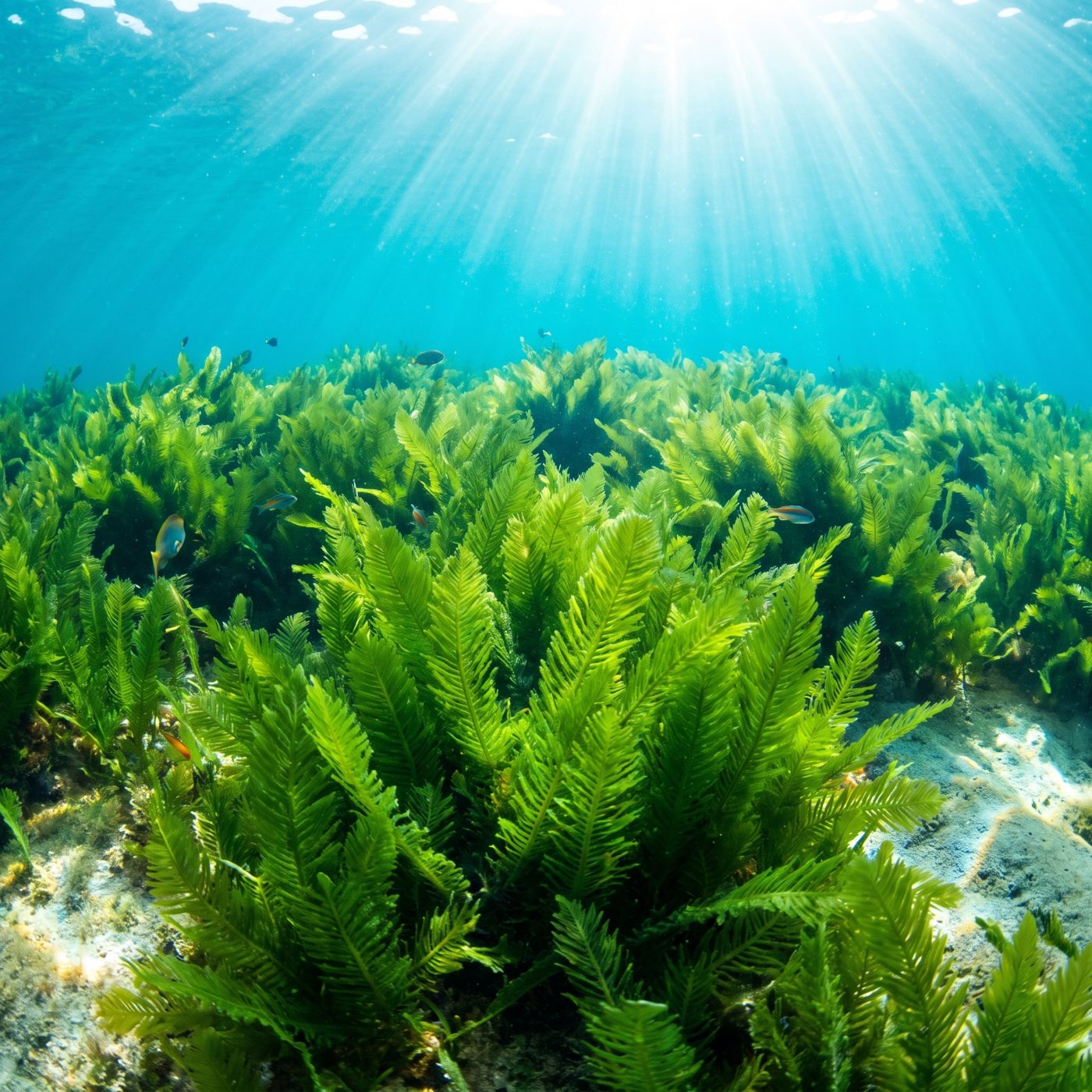 ILLUSTRATION · AI
The green weed carpeting parts of the Mediterranean seafloor is a single alga whose stolon can lengthen 3.2 centimeters a day and blanket the bottom at roughly 5,000 fronds per square meter.
Stand on the right patch of Mediterranean seabed off the French or Italian coast and you're looking at one cell. The feathery green *Caulerpa taxifolia* that spreads across it is coenocytic — a single-celled alga whose runners, blades, and anchoring filaments all belong to one continuous body without internal walls dividing it into cells. And during a Mediterranean summer, that body moves. Its horizontal runner, the stolon, can extend up to 3.2 centimeters per day, and in August it throws off a completely new upright frond every other day, packing the bottom at densities near 5,000 fronds per square meter.
Those are not casual numbers. They come from a 1995 survey published in the journal *Botanica Marina* (volume 38, pages 499–508) by Alexandre Meinesz and colleagues — Benichou, Blachier, Komatsu, Lemée, Molenaar, and Mari — who measured the structure, morphology, and biomass of the alga across its new Mediterranean range. The IUCN's Mediterranean invasive-species profile (MedMIS, 2020) and Ocean Conservancy's taxon fact sheet both report the same figures, tracing them back to Meinesz's work. The 32-millimeter-per-day stolon growth appears in Meinesz and Hesse's earlier accounts as well.
Why one cell can carpet a seafloor
The trick is the missing partitions. In most plants and animals, growth means dividing into more cells. In a coenocyte, the organism grows by adding volume and nuclei to a body that stays a single cell, so it can extend a runner across the sand without the overhead of building cell walls at every step. That architecture is part of what lets the stolon race forward centimeters a day while spinning up fresh vertical fronds on a two-day cadence.
Two clarifications matter, because the record is specific. First, these growth rates describe the invasive Mediterranean "aquarium strain," not *Caulerpa taxifolia* everywhere. In its native tropical waters the species is unremarkable. The strain that turned aggressive is a cold-tolerant clone that had circulated through public and home aquariums. Second, the frond-every-other-day pace is an August figure, the peak of the June-to-September growing season; it is not a year-round rate.
How it got there — and why it wouldn't leave
The origin story is what gives the numbers their bite. The invasion is generally traced to a small release near the Oceanographic Museum of Monaco around 1984, when a patch of the aquarium strain first appeared on the shore below. What began as roughly a square meter of green spread along the coasts of France, Spain, Italy, and beyond over the following years. Because the whole meadow can regrow from a fragment of that single continuous body, a boat anchor or a fishing net dragging through it doesn't kill the alga — it plants cuttings elsewhere.
The vivid part is standing over it. Where the strain took hold, it replaced the patchwork of seagrass and bare sand with an even, uniform green pile that suppressed the native community beneath. That is where the "killer algae" reputation came from, and why the Mediterranean case became a textbook example of how a single introduced clone can reshape a coastline.
What's still open to argue is the ending. Since its peak in the 1990s and early 2000s, many of the largest Mediterranean stands have thinned or collapsed for reasons researchers still debate — colder-than-expected winters, some form of ecological pushback, or simply the limits of the environment. Whether that retreat is durable, or whether the same growth arithmetic — 3.2 centimeters a day, a new frond every other day, 5,000 per square meter — could drive another expansion under a warming sea, is the question the seafloor hasn't settled.
More facts

Congress promised public broadcasting $9 million in 1967, then paid out only $5 million in 1968 — before Fred Rogers ever reached the Senate.

In 2019 Emma Haruka Iwao calculated pi to 31.4 trillion digits — a number so vast it took 170 terabytes to store, matching the Library of Congress.