Every Rubik's Cube position — all 43,252,003,274,489,856,000 of them — can be solved in 20 moves or fewer. Zero need 21.
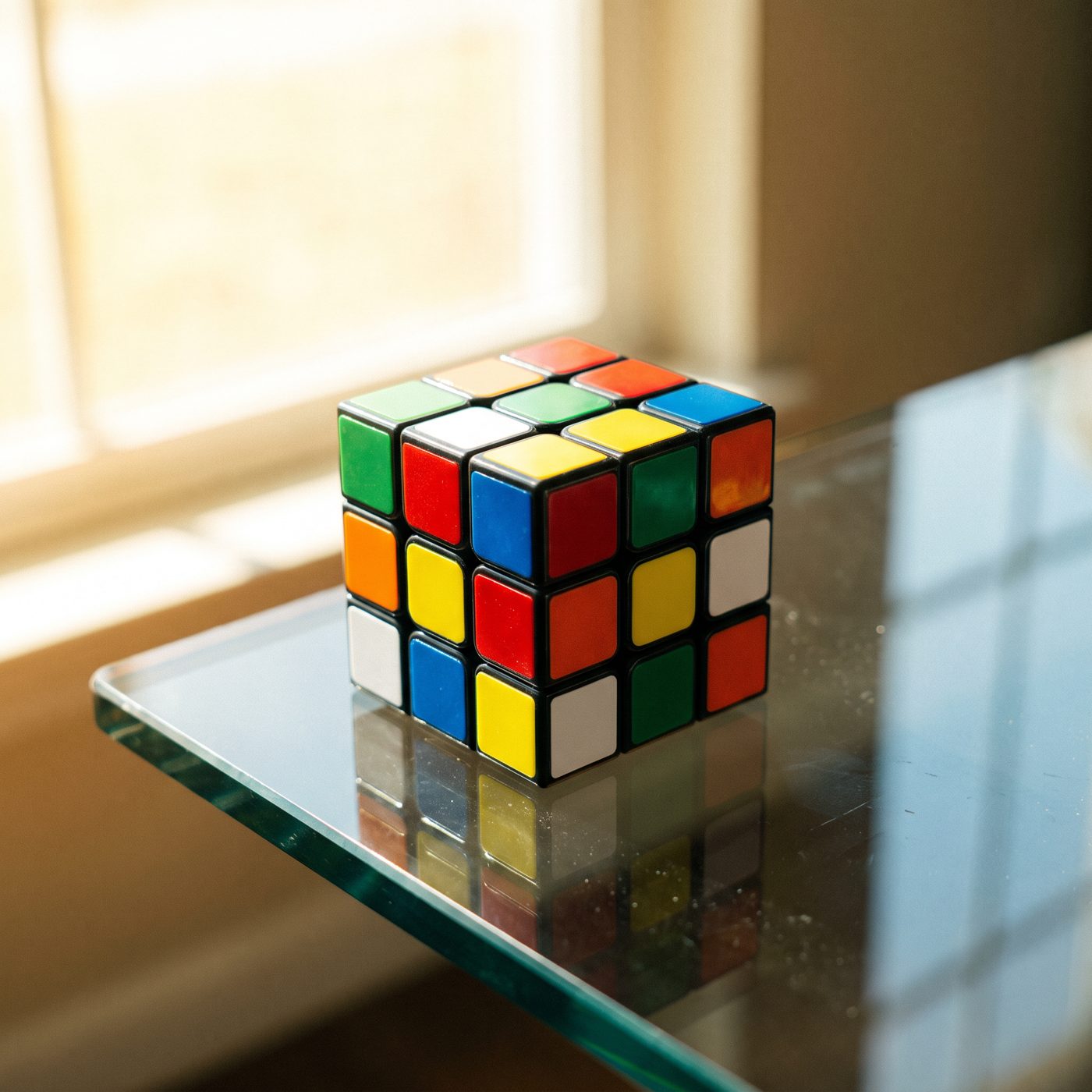 ILLUSTRATION · AI
In 2010, four researchers proved that any of the Rubik's Cube's roughly 43 quintillion scrambles can be solved in at most 20 moves — a value they named "God's Number."
Pick up a Rubik's Cube, scramble it as badly as you can, hand it to a perfect solver, and it will never take more than 20 moves to fix. Not 21, not 30 — 20, guaranteed, no matter which of the cube's 43,252,003,274,489,856,000 positions you managed to land on. That ceiling has a name among cubers: God's Number. And in July 2010 it stopped being a guess and became a theorem.
The people who nailed it down were Tomas Rokicki, Herbert Kociemba, Morley Davidson, and John Dethridge — a programmer, a math teacher and cube-software author, a mathematician, and a Google engineer, working as four equal co-authors. Their result, presented at cube20.org and later published in the SIAM Review in 2014 under the title "The Diameter of the Rubik's Cube Group Is Twenty," settled a question that had been creeping downward for decades. In the 1990s the known bound sat somewhere above 20; researchers kept proving that fewer and fewer moves would always suffice, but nobody could push the worst case all the way to the floor.
How do you check 43 quintillion positions?
You don't — not one at a time. Even at a billion positions per second, grinding through all 43 quintillion would take well over a thousand years. The trick was symmetry. Many scrambles are really the same puzzle wearing a different costume: rotate the whole cube, or mirror it, and you get a position that needs exactly the same number of moves to solve. Exploiting those symmetries, plus a clever way of solving whole families of positions at once rather than individually, Rokicki and his collaborators collapsed the problem down to about 55.9 million sets that stood in for the entire universe of scrambles.
That was still an enormous amount of arithmetic. The team needed serious hardware, and Google supplied it — roughly 35 CPU-years of idle computer time, as documented on the project's own site and echoed in Eric Weisstein's entry on "God's Number" at Wolfram MathWorld. In plain terms, a single computer would have chewed on this for about 35 years; a bank of them finished it in a matter of weeks. Every one of those 55.9 million representative sets was checked to see whether it could be solved in 20 moves or fewer. Every single one could.
Why 20, and not 19?
Here's the concrete detail that keeps the number honest: 20 isn't just an upper bound, it's exact. There genuinely exist positions that cannot be solved in fewer than 20 moves. The most famous is the so-called superflip, where every corner sits in its correct home but all twelve edges are flipped in place. It looks almost solved — nothing is out of position, everything just faces the wrong way — and yet it stubbornly demands a full 20 moves. Because such positions exist and none require more, 20 is the tight answer, the diameter of what mathematicians call the Rubik's Cube group.
One caveat worth stating plainly: this is the half-turn metric, where spinning a face 180 degrees counts as a single move. Under the stricter quarter-turn metric, where that same twist counts as two, God's Number climbs to 26. Which count is the "real" one is partly a matter of taste, and cubers still argue it.
The 2010 computation has held up. A 2025 arXiv preprint on what its authors call "a demigod's number" revisits the same territory and again clocks the effort at around 35 CPU-years, an independent nod to the original figures. What remains genuinely open isn't the answer but the method: the proof leans on brute computer search, and no one has produced a short, human-readable argument for why 20 is the magic number. The cube gave up its secret — but not yet its reasons.
More facts
The internet's first message was 'lo' — on October 29, 1969 the receiving computer crashed after just two of the five letters sent.

The first message ever sent over the internet was 'LO' — the system crashed on October 29, 1969 as Charley Kline typed the 'G' in 'LOGIN.'