NASA publishes the ISS's future position in a public file, listed every 4 minutes over 15 days, so anyone can check its 17,500 mph.
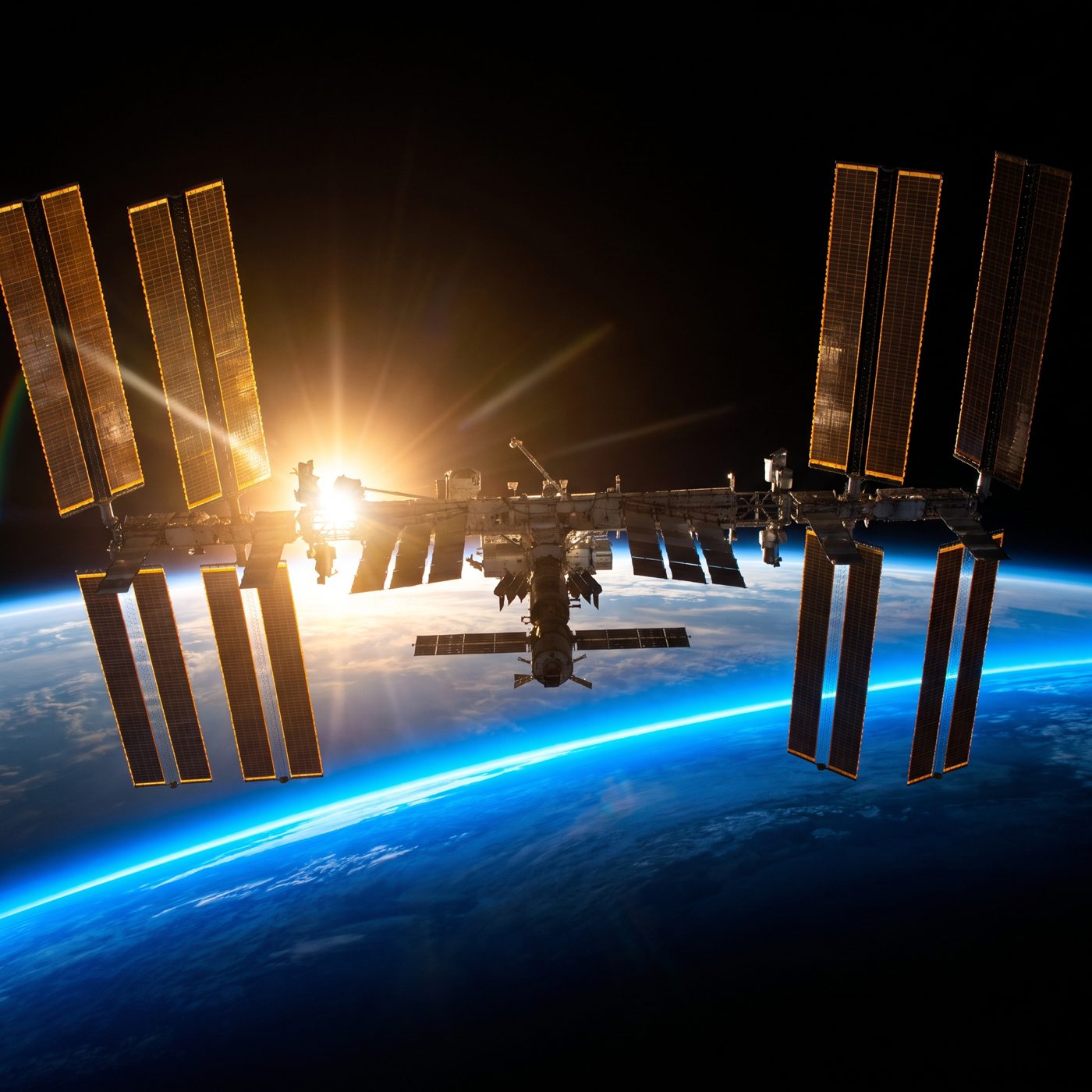 ILLUSTRATION · AI
NASA's Spot the Station page publishes the ISS's predicted trajectory as a downloadable file listing its position and velocity every four minutes for 15 days, so anyone can independently check the "17,500 mph" figure.
When NASA tells you the International Space Station circles Earth once every 90 minutes at about 17,500 mph, you don't have to take the agency's word for it. NASA hands you the raw numbers to check it yourself. On the Spot the Station page, the agency publishes the station's trajectory as a plain file—position and velocity, listed at four-minute intervals across a 15-day span—and invites you to do the arithmetic.
The file is a CCSDS Orbit Ephemeris Message, or OEM, released in both .txt and .xml. Inside it, you'll find a long column of what flight dynamics people call state vectors: for each timestamp, three numbers giving the station's position in kilometers and three more giving its velocity in kilometers per second. The coordinate frame is Mean of J2000, an inertial reference tied to Earth's orientation at the start of the year 2000, and the times are in UTC. During a reboost—when a docked spacecraft fires its engines to nudge the station's orbit higher—the intervals tighten from four minutes to two seconds, so the maneuver isn't smeared over by coarse sampling.
How you can check the 17,500 mph figure
Take any two consecutive velocity vectors from the file. Each has an x, y, and z component in kilometers per second. Square them, add them, take the square root, and you have the station's speed. Convert kilometers per second to miles per hour and the number lands right around 17,500—the same figure NASA lists in its Spot the Station Frequently Asked Questions, where it also states the roughly 90-minute orbit. Do the same with the position vectors, subtract Earth's radius, and you can recover the altitude, too. The claim and the evidence sit in the same place, on the same government page.
One honest caveat matters here. This OEM is a *predicted* ephemeris, not a live telemetry feed. It's generated ahead of time by the TOPO flight controllers—Trajectory Operations Officers—working at NASA's Johnson Space Center in Houston. So the file tells you where the station is expected to coast, not a real-time readout of where it is this second. That's exactly why it can look forward 15 days: it's a forecast, refreshed as new tracking data comes in.
How we know NASA actually publishes this
The documentation is on NASA's own Spot the Station site, which spells out the four-minute intervals, the 15-day span, the two-second reboost sampling, and the Mean-of-J2000 frame. The arrangement predates that page: when NASA retired spaceflight.nasa.gov in 2023, it moved the ISS.OEM_J2K_EPH files—the .txt and .xml versions—to permanent Amazon S3 links so the predicted coasting state vectors at four-minute intervals would stay publicly reachable.
The current arrangement was announced in December 2024 and picked up by outlets including Phys.org and Mirage News, all republishing the same NASA release describing the four-minute intervals over 15 days, the two-second reboost sampling, and the ephemeris generated by TOPO at JSC. This is the kind of fact that survives independent checking precisely because independent checking is the point.
There's something quietly radical about the format itself. The CCSDS standard—maintained by the Consultative Committee for Space Data Systems, an international body of space agencies—exists so that one agency's orbit data can be read and used by another's software without translation. NASA didn't invent a proprietary format to describe its own crown-jewel station; it used the same interchange standard the rest of the spacefaring world speaks.
What's still open to argue is how well the forecast holds. Atmospheric drag varies with solar activity, and even a lightly resisted orbit decays; the station is nudged back up periodically, which is why those two-second reboost windows exist. So the numbers you pull from today's file are a good bet, not a guarantee. The genuinely satisfying test is to download tomorrow's file and see how far the prediction drifted—the difference is the atmosphere itself, written in kilometers per second.
More facts

The world's first feature film, 1906's The Story of the Kelly Gang, had no printed words — live actors behind the screen supplied every gunshot and hoofbeat.

Every Rubik's Cube position — all 43,252,003,274,489,856,000 of them — can be solved in 20 moves or fewer. Zero need 21.