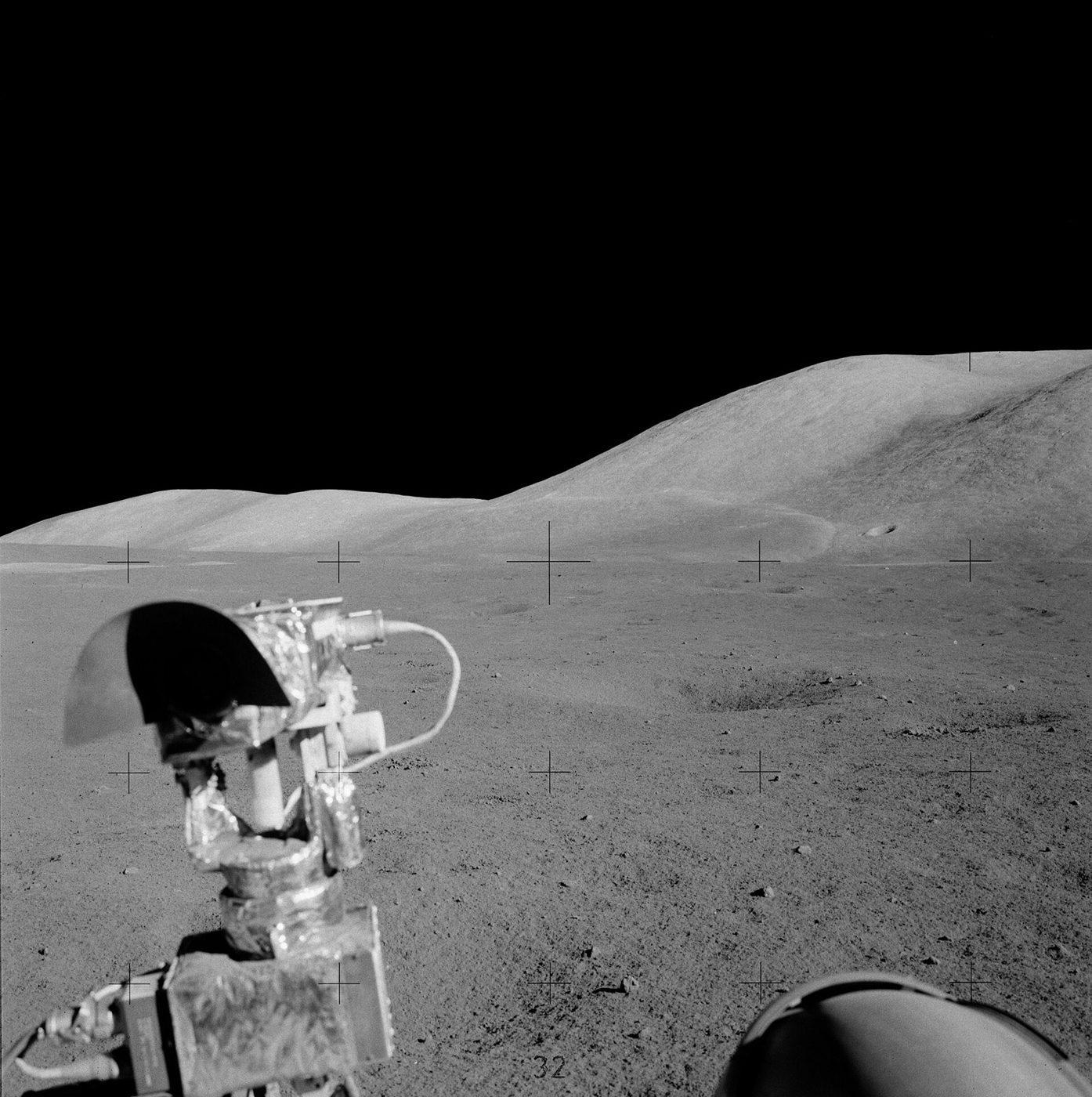
The black hole at the Milky Way's center spans 51.8 microarcseconds in our sky — the width of a donut on the Moon seen from Earth.
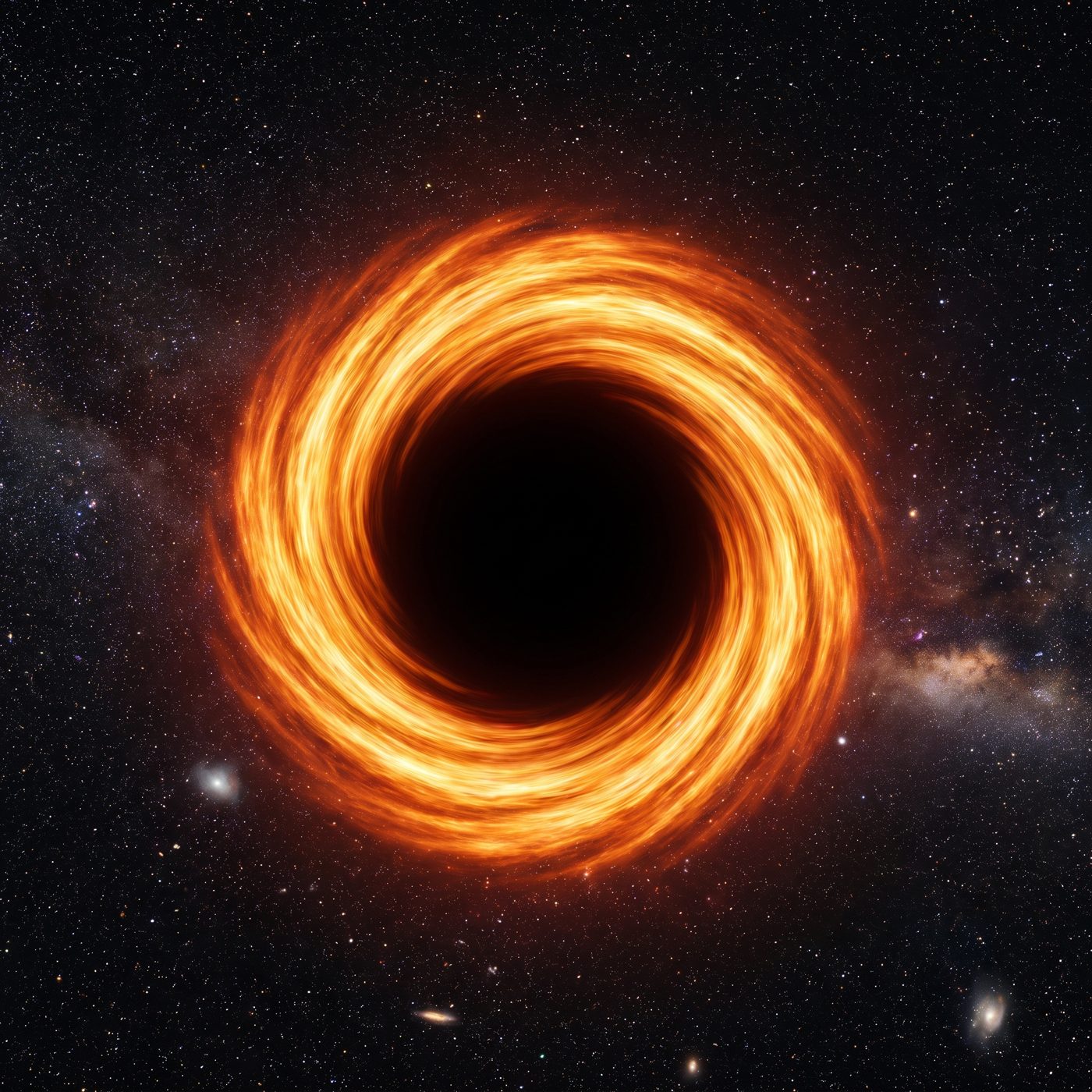 ILLUSTRATION · AI
The Event Horizon Telescope's 2022 image of Sagittarius A* reveals a bright emission ring 51.8 ± 2.3 microarcseconds across, the size a donut on the Moon would appear from Earth.
In May 2022, the Event Horizon Telescope Collaboration released the first direct image of Sagittarius A*, the supermassive black hole at the heart of our galaxy. The picture shows a bright, thick ring of light 51.8 ± 2.3 microarcseconds in diameter. To grasp how tiny that is: it's roughly the angular size of a donut sitting on the surface of the Moon, viewed from your backyard on Earth. Encircled by that ring is a dark central region — the shadow — measured at about 48.7 microarcseconds.
That measurement is the payoff, and it's not just a pretty portrait. The ring's size is exactly what Einstein's general relativity predicts for a spinning (Kerr) black hole weighing about four million times the mass of our Sun, sitting some 27,000 light-years away.
How the EHT measured a black hole nobody can see
You cannot photograph a black hole directly — by definition, nothing escapes it. What the EHT captured is the glow of hot gas swirling just outside the event horizon, bent into a ring by the black hole's gravity, with the shadow of the horizon punched out of the middle.
To resolve something this small, the collaboration linked radio telescopes across the planet — from Hawaii to Chile to the South Pole — into a single Earth-sized instrument using a technique called very long baseline interferometry. The data came from observations in April 2017; it took five years of painstaking analysis to turn those signals into an image, because Sagittarius A* flickers and shifts on the scale of minutes, unlike the far larger and slower M87* black hole the EHT imaged first in 2019.
The measurement itself was carefully guarded against wishful thinking. As the collaboration reported in *The Astrophysical Journal Letters* (paper I, ApJL 930:L12, 2022), the team combined geometric modeling of the ring with image-domain feature extraction to arrive at a "debiased" diameter of 51.8 ± 2.3 microarcseconds — the value later reaffirmed in their 2024 variability-and-mass analysis (paper IV). That's the ring. The angular shadow, quoted separately, is 48.7 ± 7 microarcseconds.
Why the ring size, not the shadow, confirms Einstein
Here's a subtlety worth getting right. The number people often cite — 51.8 microarcseconds — is the diameter of the bright emission *ring*, not the shadow. It's the ring's measured size that lines up with the theoretical prediction for a Kerr black hole of about 4 × 10⁶ solar masses. The shadow, being harder to pin down, carries a much larger error bar.
The mass and distance didn't come out of thin air, either. They were established over decades by tracking individual stars whipping around the galactic center — work led by teams under Andrea Ghez and Reinhard Genzel, who shared the 2020 Nobel Prize in Physics for it — and cross-checked with radio measurements of water masers. Feed that mass and distance into general relativity, and it predicts a ring almost precisely the size the EHT saw. The image and the stellar orbits, gathered by completely different methods, agreed.
That agreement is the quiet triumph. As AAS Nova summarized in 2022, the ring encircling the 48.7-microarcsecond shadow matched what relativity demands for a four-million-solar-mass black hole. Two independent windows onto the same invisible object told the same story.
What's still open
The remaining arguments are honest ones. Sagittarius A* varies so rapidly that any single "image" is really an average over a turbulent, ever-shifting glow, and reconstructing it required choices the collaboration continues to test. The black hole's spin — how fast it rotates and which way its axis points — remains poorly constrained. And the shadow's size still carries enough uncertainty that pinning down finer deviations from general relativity, if any exist, will take sharper future observations. The portrait is real. The full biography is still being written.
More facts
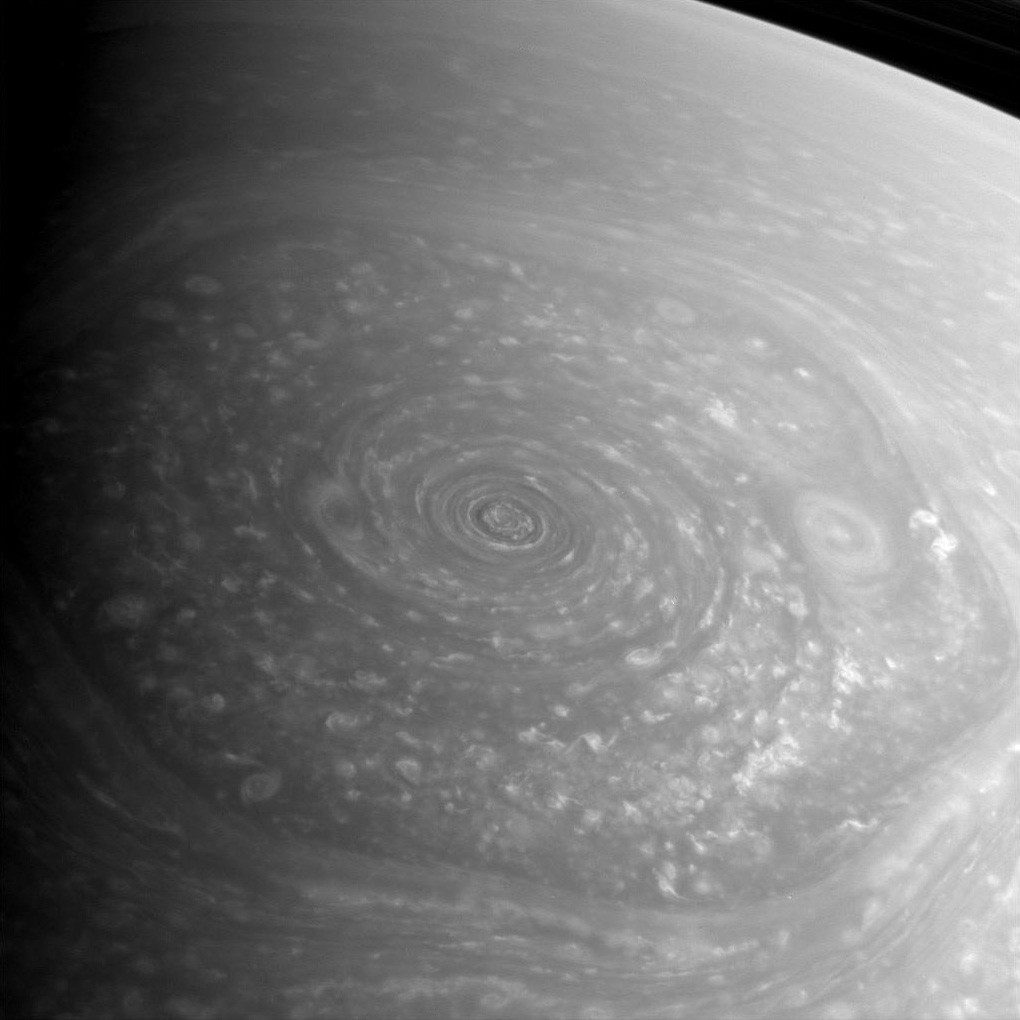
A six-sided storm pattern circles Saturn's north pole. The hexagon spans about 20,000 miles and is a jet stream of 200-mile-per-hour winds, NASA says.
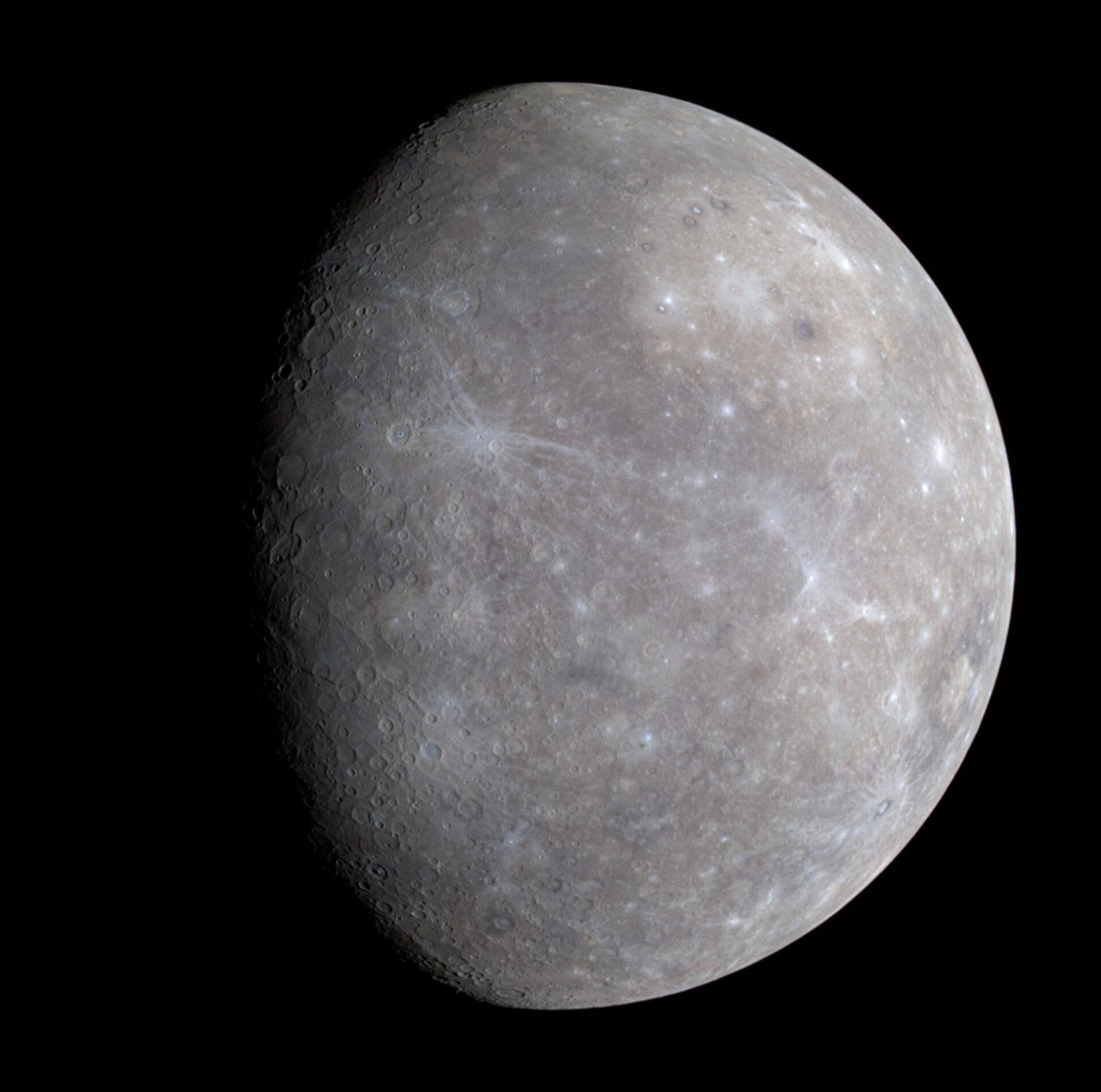
Daytime on Mercury can reach 800 degrees Fahrenheit. With no substantial atmosphere to hold that heat, nights can plunge to minus 290 degrees, NASA says.