The internet's first message was 'lo' — on October 29, 1969 the receiving computer crashed after just two of the five letters sent.
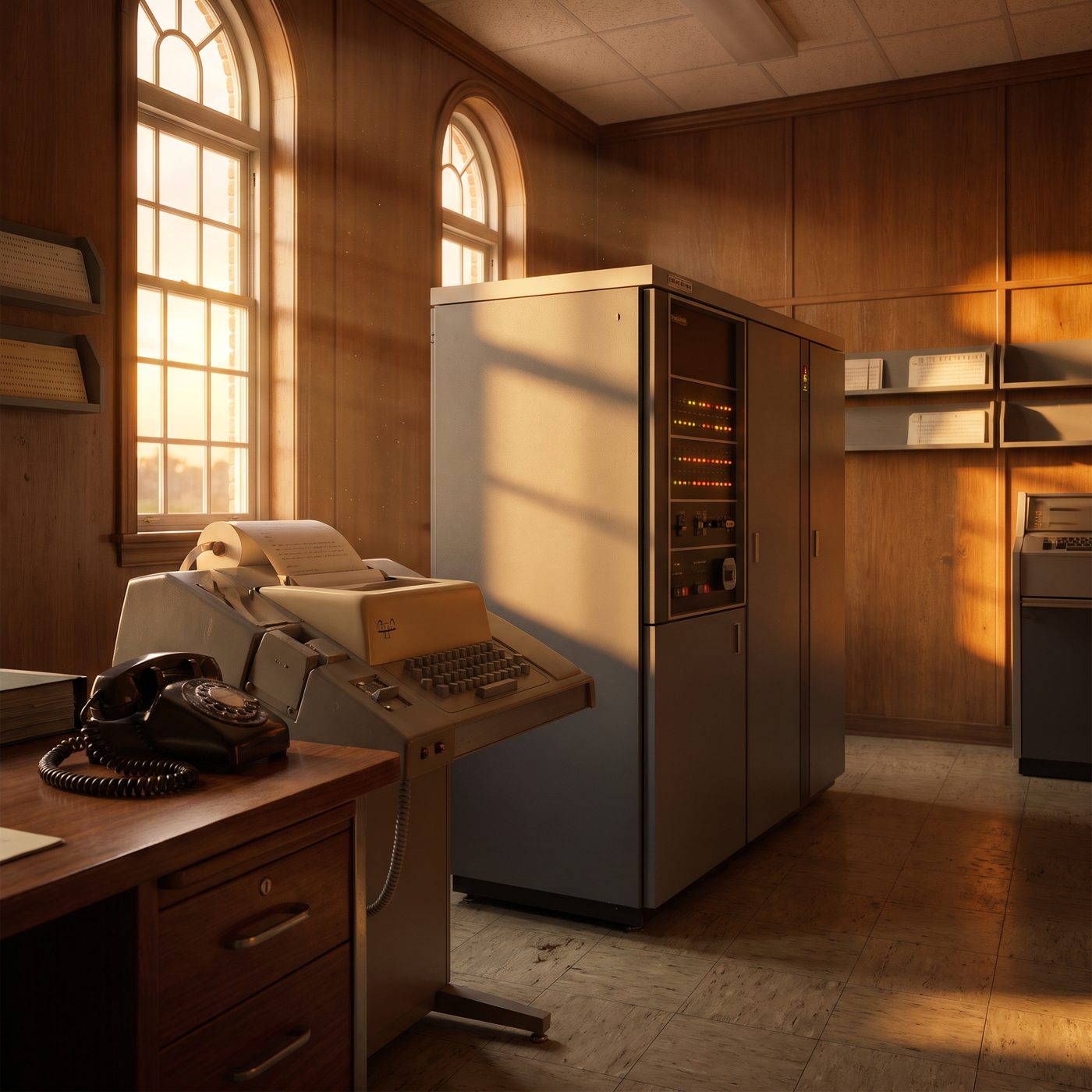 ILLUSTRATION · AI
On October 29, 1969, the first message sent between two computers over the ARPANET was meant to be "login," but the receiving machine crashed after the letters "l" and "o," making the internet's first word "lo."
The internet's first transmitted message was two letters long: "lo." It wasn't a joke, a code, or a greeting. It was the first two characters of the word "login," and the computer on the other end crashed before the rest could arrive. The accidental result — "lo," as in "lo and behold" — is one of the more fitting flukes in the history of technology.
How the first message got sent — and cut short
The setup was two machines roughly 350 miles apart. At UCLA sat an SDS Sigma 7 computer, operated that night by a student programmer named Charley Kline. At the Stanford Research Institute (SRI) in Menlo Park sat an SDS 940, operated by Bill Duvall. The goal was simple in concept and unprecedented in practice: get one computer to log in to the other across a network.
What makes the moment human rather than purely mechanical is that Kline and Duvall weren't relying on the network alone to coordinate. Each man wore a telephone headset, and the two were talking to each other by voice in real time as the data went across. The telephone was the backup channel for the computers that were supposed to replace it.
Kline began typing "login." He typed the "l," and over the headset asked Duvall whether it had come through. It had. He typed the "o" — also received. Then he typed the "g," and at that point the SRI system crashed. The connection died with exactly two letters delivered: "lo."
How we know this actually happened
The account comes straight from the people who were there and from the paperwork they kept. Leonard Kleinrock, who ran the UCLA lab where the transmission originated, has published the story in two places that line up with each other. In his 2019 piece "The Day the Infant Internet Uttered its First Words," written for UCLA, he reproduces the lab's handwritten IMP Log — the primary document from that night — and names Kline, Duvall, their two machines, the "login" attempt, and the crash after "l" and "o."
In a companion first-person account on the ICANN Blog, also from 2019, Kleinrock states plainly that Kline and Duvall "each had a telephone headset so they could communicate by voice as the message was being transmitted," and that the system failed on the "g" after the first two letters went through.
Duvall himself confirmed the headset detail on the record. In Guy Raz's 2009 NPR segment "Lo And Behold: A Communication Revolution," Duvall recalled, "We were hooked up with a telephone headset, and we were talking to each other." The segment places Kline's call to Duvall on the night of October 29, 1969.
The vivid, verifiable detail is that IMP Log page. Lab notebooks were kept as a matter of routine, not ceremony, and the entry marking the first host-to-host message was written in the same plain hand as everything else that night. Nobody at the time treated it as the birth of anything. It was a test that half-failed.
What's still worth arguing about
The clean story — "the first internet message was 'lo'" — is true, but it invites a fair objection: was this the internet, or just a precursor to it? The ARPANET of 1969 was not the global, protocol-unified network we use now. The modern internet's defining technology, the TCP/IP suite developed by Vinton Cerf and Robert Kahn, wouldn't be standardized across the ARPANET until January 1, 1983. Depending on where you draw the line, October 29, 1969, is either the internet's first word or the first word of something that would later become the internet.
There's also the quieter irony that the two engineers coordinating the first computer-to-computer message did it by talking on the phone. The network they were building would, within a few decades, make that phone call feel quaint. On its first night, it couldn't say five letters without help.
More facts
The first message ever sent over the internet was 'LO' — the system crashed on October 29, 1969 as Charley Kline typed the 'G' in 'LOGIN.'

Emma Haruka Iwao's 2019 record held 31,415,926,535,897 digits of pi — and every one was checked without recomputing the whole thing.