A radio command to Voyager 1 now takes over 23 hours to arrive — on Nov. 18, 2026 it hits exactly 24, a full light-day away.
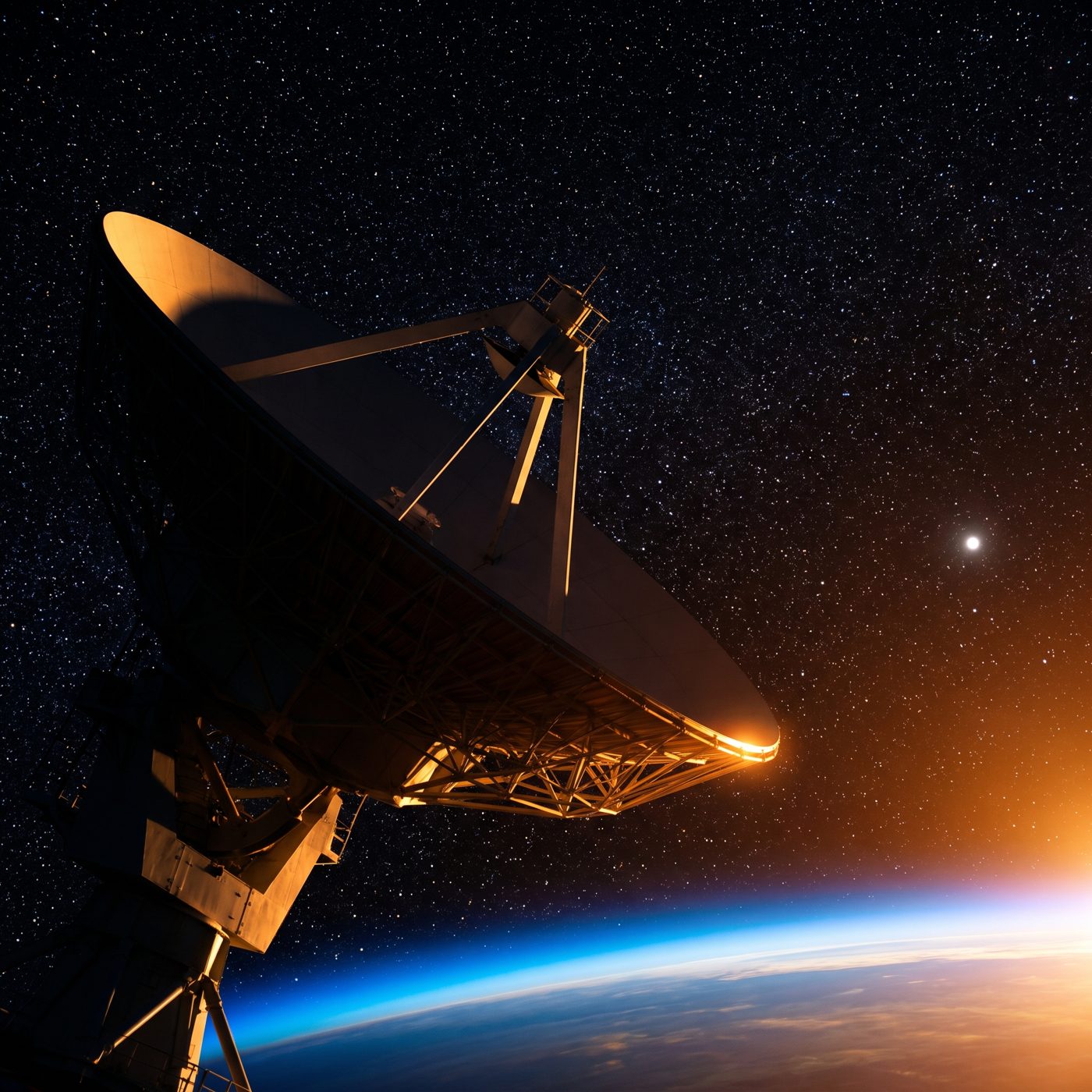 ILLUSTRATION · AI
A radio command sent from Earth to Voyager 1 now takes more than 23 hours to arrive, and on Nov. 18, 2026 that one-way trip will hit exactly 24 hours — one full light-day.
Say "good morning" to Voyager 1 at 8 a.m. on a Monday, and you won't hear back until roughly Wednesday. That's not a limitation of the hardware so much as a limitation of physics: the spacecraft is now so far away that a radio signal — traveling at the speed of light, the fastest anything can go — takes more than 23 hours just to reach it. The reply takes just as long coming home.
Suzy Dodd, the Voyager project manager at NASA's Jet Propulsion Laboratory, used exactly that "good morning" example in a 2025 interview with CNN to make the delay tangible. The command goes out, crosses billions of miles of empty space for the better part of a day, prompts a response, and that response crawls back across the same gulf. Round trip: nearly two full days for a single exchange.
Why the signal takes so long
Voyager 1 launched in 1977 and has never stopped moving away from us. As of late 2025 it sits roughly 15.8 billion miles from Earth, the most distant human-made object in existence. At that range, the one-way light time is about 23 hours and 32 minutes — Popular Science, reporting the same year, put it plainly as "a little over 23 hours" per command.
The reason the delay keeps growing is simply that the probe keeps receding, at about 38,000 miles per hour. Light is constant; the distance it has to cover is not. So the lag creeps upward month by month, an unusually direct way to watch cosmic scale expressed as time on a clock.
The one-light-day milestone
NASA's own "Where Are Voyager 1 and 2 Now?" tracker names the moment with startling precision. On Wednesday, Nov. 18, 2026, at 2:16:07 a.m. Pacific Standard Time, Voyager 1 will be 16,094,799,096 miles — 25.902 billion kilometers — from Earth. At that instant, the one-way signal time reaches exactly 24 hours.
That is the definition of one light-day: the distance light travels in a single day. It's a unit astronomers rarely get to apply to anything humans built, because almost nothing we make ever leaves the neighborhood. A light-year, the distance to even the nearest stars, is 365 times farther still. Voyager 1, after nearly half a century of flight, is only now crossing the first day of that journey.
The vivid part is how ordinary the engineering has to be to keep the conversation going. NASA's Deep Space Network — the array of giant dish antennas in California, Spain, and Australia that keeps a fix on the probe — is listening for a signal broadcast by a transmitter running on roughly the power of a refrigerator light bulb, weakened by billions of miles until it arrives as a whisper measured in fractions of a billionth of a watt. Catching it at all, and pulling commands and telemetry out of that faint hiss, is arguably the more remarkable feat than the distance itself.
What's still open
The interesting question isn't whether Voyager 1 will hit the light-day mark — the orbital mechanics are settled. It's whether we'll still be talking to it when it does. The spacecraft's plutonium power source fades a little every year, and engineers at JPL have spent recent years shutting down instruments and heaters to stretch the remaining wattage. Dodd's own team has warned the mission may fall silent sometime in the late 2020s, not because Voyager stops flying but because it stops having enough power to speak.
So the milestone carries a quiet gamble inside it. When Nov. 18, 2026 arrives and the one-way time clicks over to a full 24 hours, there may still be a working transmitter on the far end to acknowledge a "good morning" — or there may just be a dark, coasting machine, crossing the line in silence.
More facts
The internet's first message was 'lo' — on October 29, 1969 the receiving computer crashed after just two of the five letters sent.
The first message ever sent over the internet was 'LO' — the system crashed on October 29, 1969 as Charley Kline typed the 'G' in 'LOGIN.'