A Rubik's Cube has exactly 43,252,003,274,489,856,000 possible states — but only 1 in 12 of the arrangements you could build by hand can ever be solved.
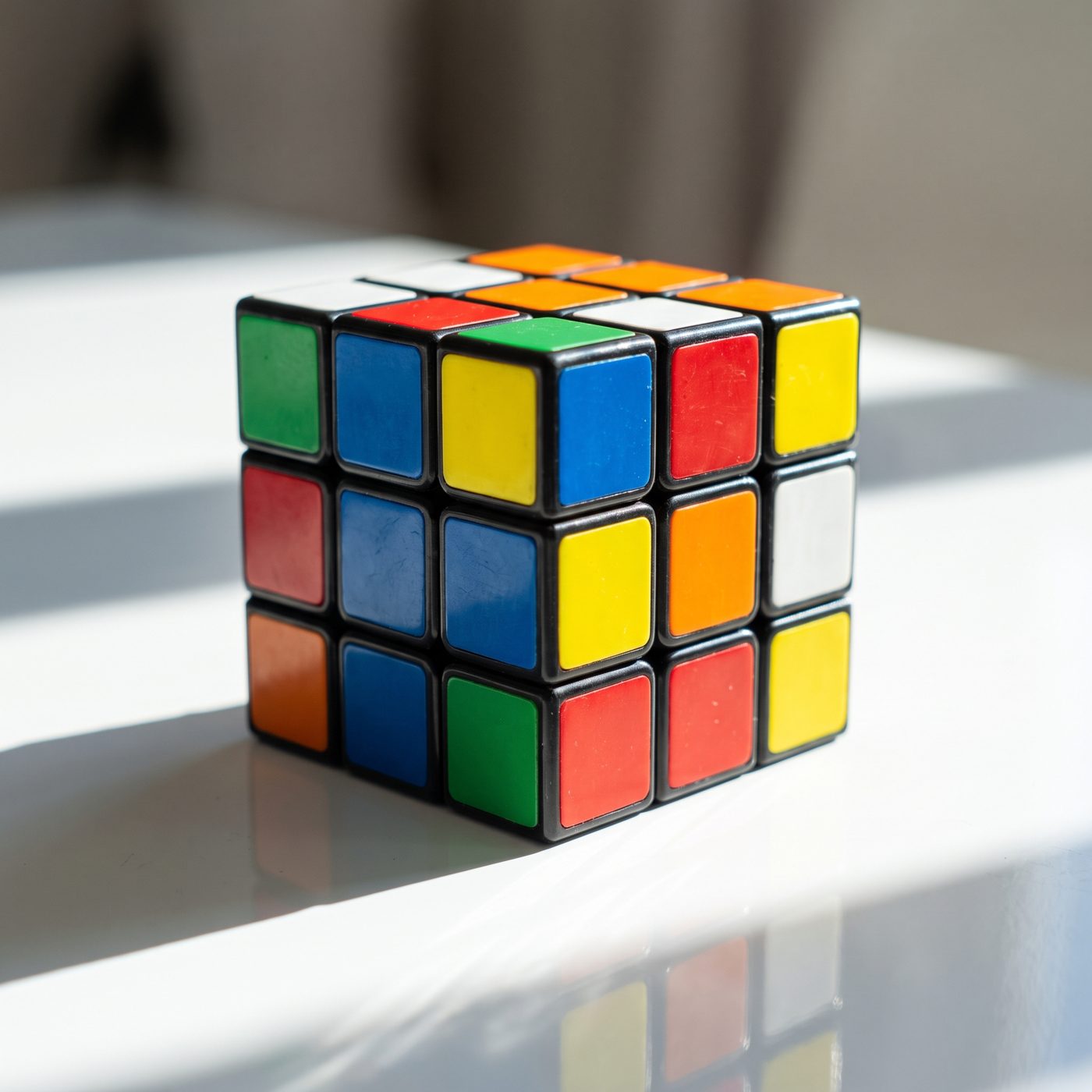 ILLUSTRATION · AI
A standard Rubik's Cube has exactly 43,252,003,274,489,856,000 solvable states, and only one out of every twelve arrangements you could physically build is one of them.
Take a Rubik's Cube apart — pop the pieces off with a screwdriver, the way an impatient child does — and reassemble them at random. There is only a one-in-twelve chance the cube you rebuilt can ever be solved. That number, 43,252,003,274,489,856,000, is the exact count of legal states, and it is dwarfed by the 12-times-larger set of arrangements that look fine but are permanently broken. The math tells you which is which before you ever turn a face.
That total — roughly 43 quintillion — isn't an estimate. It's the order of a mathematical object called the Rubik's group, and it can be written in one line: (8!·3⁷·12!·2¹¹)/2. Bagai, Konen, and colleagues lay out the full derivation in their 2023 paper on teaching a machine to solve the cube (arXiv:2301.12167), and every term in that formula corresponds to something physical on the toy in your hand.
How the formula counts the cube
Start with the eight corner pieces. They can sit in any of 8! = 40,320 orderings. Each corner can be twisted into one of three orientations, giving 3⁸ — except the last corner's twist is forced by the other seven, so the honest count is 3⁷. The twelve edge pieces contribute 12! positions and 2¹² flip states, again with the last flip determined by the rest, leaving 2¹¹.
Multiply those together and you overshoot the true answer by a factor of two. That factor is the interesting part.
Why only 1 in 12 can be solved
The division by 2 comes from a parity law. On a real cube, every legal move is a quarter-turn of a face, and each such turn swaps corners and edges in matched pairs. The upshot is that you can never, through legal turns, exchange just two pieces while leaving everything else untouched. Corners and edges cannot be transposed in isolation.
So three separate constraints quietly shrink the space: the corner twists must sum to a multiple of three (that's the 3⁸ collapsing to 3⁷), the edge flips must sum to an even number (2¹² down to 2¹¹), and the overall permutation of pieces must be even (the final divide by 2). Break any one of these when you reassemble by hand and you've built one of the eleven-in-twelve cubes that no amount of turning will fix. Wolfram MathWorld writes the same result with all three divisors visible — (8!·12!·3⁸·2¹²)/(2·3·2) — and it lands on exactly the same integer.
The concrete version of this is the "unsolvable" cube that circulates as a prank: swap a single pair of edge stickers, or pluck out one corner and reseat it rotated a third of a turn, and the puzzle becomes literally impossible. It looks identical to a fresh cube. It is not.
How we know the number is exact
This is arithmetic on a finite group, not a survey, so the figure admits no error bar. A 2026 paper by Damele, Loi, Mereb, and Vendramin — titled, with a wink, "Galois' Professor's Revenge" (arXiv:2509.09662) — confirms the order and gives its prime factorization: 2²⁷·3¹⁴·5³·7²·11. That decomposition is a fingerprint. It means the cube's symmetry is built almost entirely from small primes; the largest, 11, appears just once. Multiply those primes out and you return to 43,252,003,274,489,856,000, digit for digit.
What stays open is not the count but its reach. Nobody solves 43 quintillion positions by hand; the question that occupied mathematicians for decades was how far the worst case sits from solved. The answer, established by computer search in 2010, is twenty moves — "God's Number." That every one of these quintillions of states lies within twenty turns of order is a fact about the same group, and a far harder one to prove than the size of the group itself.
More facts

Congress promised public broadcasting $9 million in 1967, then paid out only $5 million in 1968 — before Fred Rogers ever reached the Senate.

In 2019 Emma Haruka Iwao calculated pi to 31.4 trillion digits — a number so vast it took 170 terabytes to store, matching the Library of Congress.