The Space Station travels the distance from Earth to the Moon and back every single day — orbiting the planet once every 90 minutes.
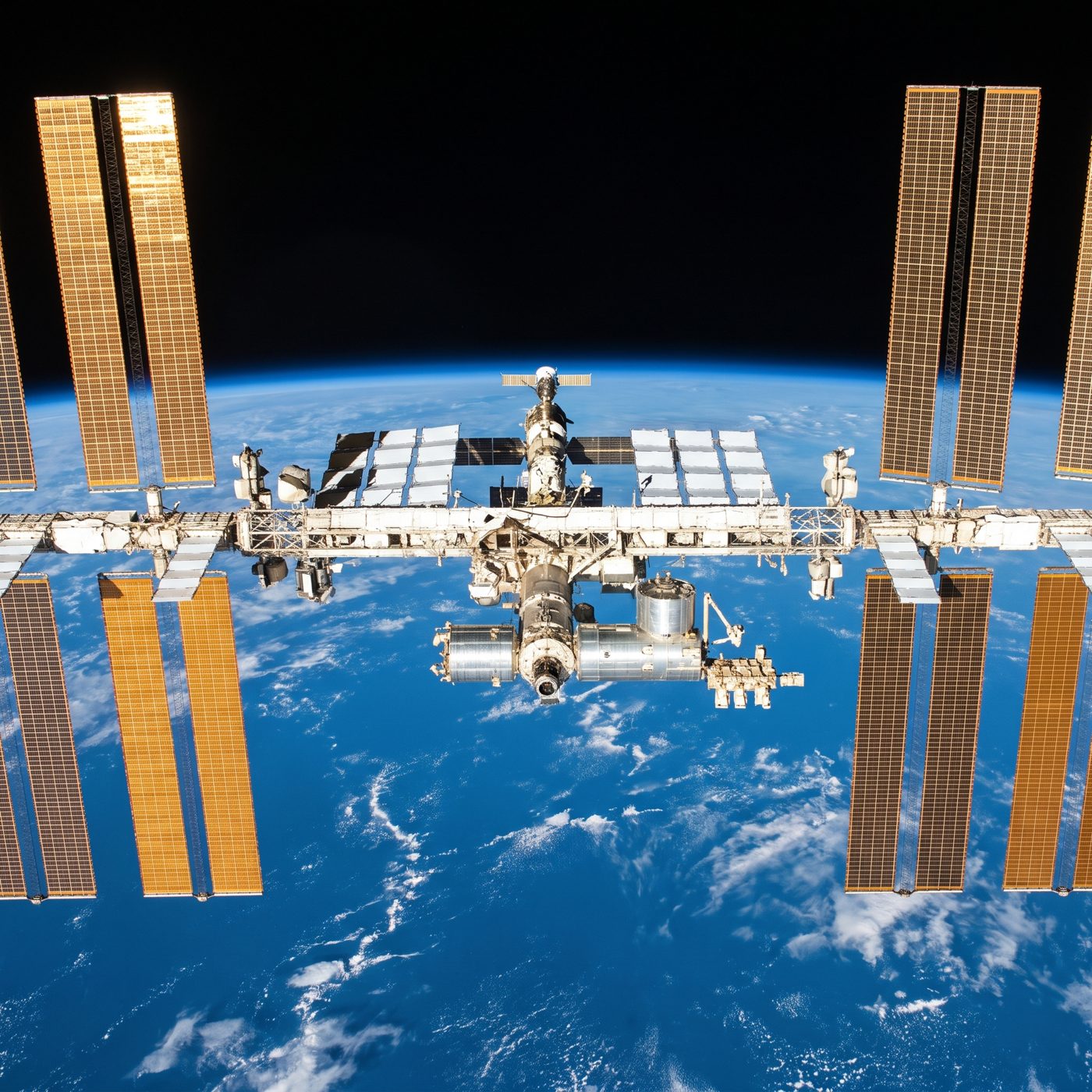 ILLUSTRATION · AI
The International Space Station circles Earth every 90 minutes at about 17,500 mph, covering roughly the round-trip distance to the Moon in a single day.
Every 24 hours, the astronauts aboard the International Space Station travel about as far as it is to the Moon and back — without ever leaving low Earth orbit. NASA's "International Space Station Facts and Figures" page makes the comparison directly: in about a day, the station covers a distance equivalent to going from Earth to the Moon and returning. It does this not by heading anywhere in particular, but by racing around the planet sixteen times.
The arithmetic is easy to check. NASA's education material for grades 5–8 puts the station's speed at 17,500 mph. Multiply that by 24 hours and you get roughly 420,000 miles. The average distance to the Moon is about 239,000 miles, so a round trip is close to 478,000 miles — the same ballpark, which is why NASA frames it as an equivalent, not an exact match. The point is the scale: the station eats up interplanetary-sounding distances in an ordinary day.
Why the Space Station orbits every 90 minutes
The pace isn't a design choice — it's physics. To stay in orbit at an altitude of about 250 miles, an object has to move fast enough that the curve of its fall matches the curve of the Earth. Go slower and you spiral down; the atmosphere thickens and drag pulls you back. At 250 miles up, the speed that balances gravity works out to roughly five miles per second, which NASA's facts page states plainly. Space.com's NASA-sourced "By the Numbers" rundown gives the same figure, 4.8 miles per second, and the same 90-minute lap.
At that speed the whole planet passes beneath the station in an hour and a half. That's why crew members famously see about sixteen sunrises and sixteen sunsets in a single day — one for each orbit. NASA's figures spell out that cadence: sixteen orbits per 24 hours.
How we know the numbers hold up
These aren't back-of-the-envelope estimates. The station's position and velocity are tracked continuously and published as orbital telemetry, and the figures line up across NASA's own documents. The 2024 "Facts and Figures" page, the 2025 education explainer, and Space.com's NASA-sourced compilation all converge on the same picture: about 250 miles up, roughly 90 minutes per orbit, close to five miles per second.
There's a small honest wrinkle worth naming. NASA's facts page describes the speed as "five miles per second," which multiplies out to about 18,000 mph, while its education pages and most popular references cite the rounder 17,500 mph. Both are correct within the precision anyone needs — the station's exact speed shifts slightly as its altitude drifts. That's the concrete detail most people miss: the ISS is slowly, constantly falling. Atmospheric drag, thin as it is at that height, drags the station downward by a small amount every day. Left alone, it would eventually re-enter and burn up.
So the station is periodically "reboosted" — nudged back up to a higher orbit using thrusters, often on a visiting cargo vehicle. Each reboost tweaks the altitude, and with it the precise speed and orbital period. That's why the numbers you'll see are always given as "about" 250 miles and "roughly" 17,500 mph rather than fixed constants.
Which leaves one genuinely open question, and it's not about the math. The station has been drifting and reboosting since 2000, but that maintenance can't go on forever. NASA plans to deorbit the ISS around 2030, guiding it to a controlled fall into a remote stretch of the Pacific. The daily Earth-to-Moon-and-back journey has a firm end date — and what replaces it, whether commercial stations or something else entirely, is still being argued over.
More facts

Taylor Swift's Eras Tour grossed $2,077,618,725 — the first concert tour in history to pass $2 billion, across just 149 shows.