Gordon Gould coined the word 'laser' in 1957, but the U.S. Patent Office made him wait until 1977 to hold his first laser patent.
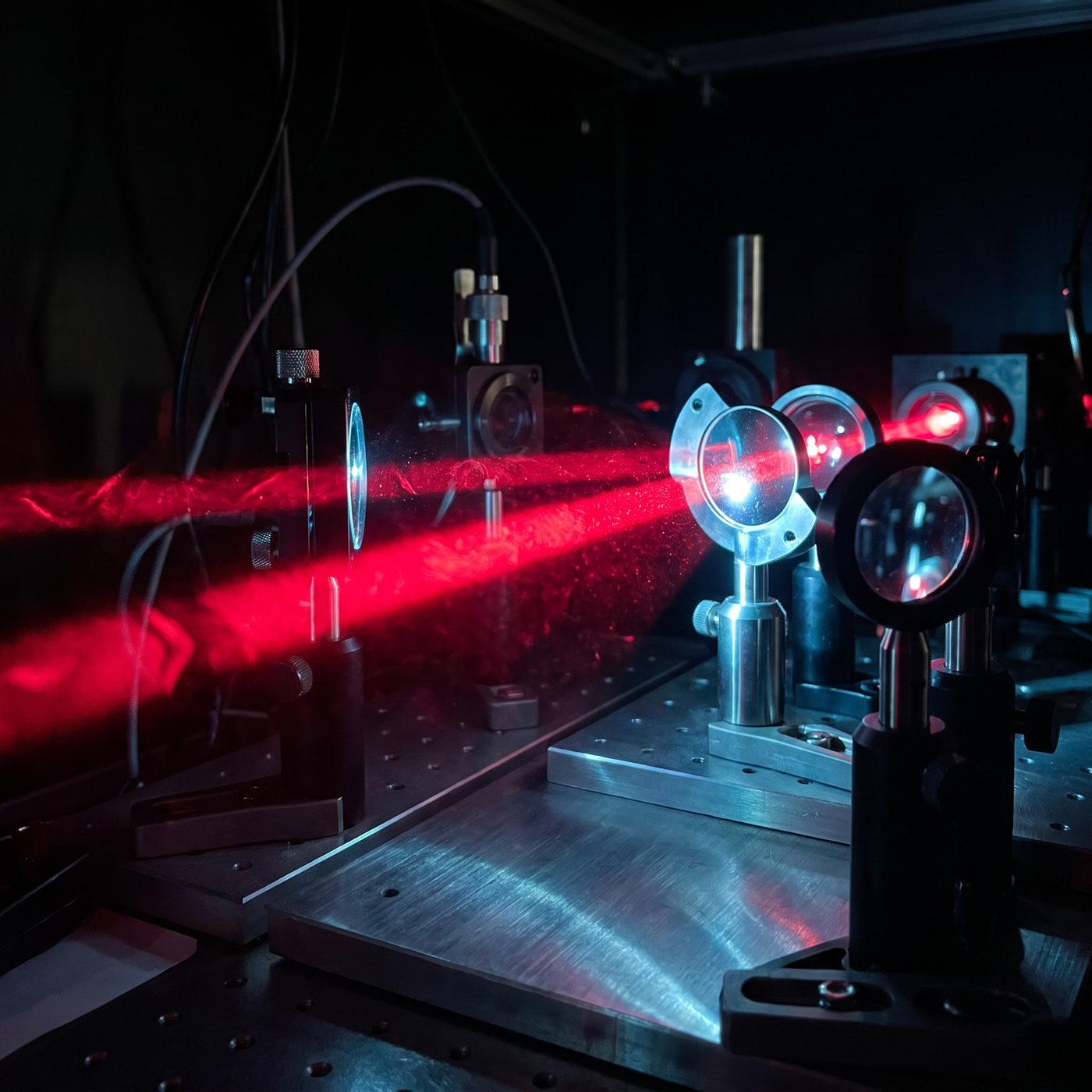 ILLUSTRATION · AI
Gordon Gould named the laser and sketched how to build one in a notebook he had notarized in November 1957, but the U.S. Patent Office didn't grant him his first laser patent, No. 4,053,845, until October 11, 1977.
Gordon Gould wrote the word "LASER" at the top of a page in a spiral notebook in November 1957, then walked it down to a candy-store notary in the Bronx to have it witnessed and dated. That notebook coined the acronym still in use today—Light Amplification by Stimulated Emission of Radiation—and laid out the essentials of an optically pumped device. But holding a patent for the idea took him nearly two decades. The Science History Institute, in its 2023 account "The Man, the Myth, the Laser," pins the gap precisely: the first patent arrived in 1977, twenty years after Gould's notebook was notarized on November 13, 1957.
That first patent, U.S. Patent No. 4,053,845, "Optically Pumped Laser Amplifiers," was issued October 11, 1977. The federal court in *Gould v. General Photonics Corp.* (N.D. Cal. 1982) recites the fact in plain language: the patent "was issued October 11, 1977 to Gordon Gould as the inventor."
Why did it take twenty years?
The delay wasn't the Patent Office being slow to read a single application. It was a war of attrition. According to Encyclopædia Britannica, Gould applied in 1959 and was rejected. He had made a crucial early mistake—believing he needed a working prototype before filing—so by the time he applied, Charles Townes and Arthur Schawlow at Bell Labs had already filed their own laser patent, and theirs issued in 1960. The Patent Office treated their claim as controlling and turned Gould away.
What followed was one of the longest patent fights in American history. Gould, backed by investors and lawyers, spent years arguing that his 1957 notebook proved he had conceived the ideas first, and that the notarized, dated pages were the documentary proof. The court in the 1982 General Photonics case traced the application lineage of the '845 patent back to a filing of April 6, 1959—a paper trail that had been winding through appeals and refilings for eighteen years by the time the patent finally granted.
How we know the dates hold up
The strength of this story is that it isn't told only by Gould's admirers. The 1977 grant date and Gould's name as sole inventor come straight from a U.S. federal court opinion, which had no incentive to flatter him and every reason to state the record accurately. The patent document itself, preserved in the Google Patents and OSTI.GOV records, carries the same October 11, 1977 date and lists the application as filed August 16, 1974—one of the refilings in that long chain reaching back to 1959. Britannica independently confirms that the 1977 patent was "the first of the four U.S. basic laser patents" Gould would eventually win.
The concrete detail worth holding onto is the candy store. Gould, a Columbia graduate student, didn't have a lab notary or a corporate legal department in 1957. He carried his pages to a neighborhood shop and had them stamped—an ordinary transaction that later became a linchpin of expert testimony, because a notarized date is hard to fake after the fact.
Gould eventually collected royalties estimated in the tens of millions once his patents held. But the seam that still invites argument is priority itself. Townes and Schawlow published the foundational theory and won the Nobel Prize; Gould coined the name and, he insisted, worked out the practical device first. Both sides had notebooks, filings, and lawyers. The Patent Office and the courts ultimately credited Gould with enough to grant him four basic patents—yet historians of science still debate how much of the laser any single person can be said to have invented, and whether twenty years of litigation settled the question or merely outlasted it.
More facts
The internet's first message was 'lo' — on October 29, 1969 the receiving computer crashed after just two of the five letters sent.
The first message ever sent over the internet was 'LO' — the system crashed on October 29, 1969 as Charley Kline typed the 'G' in 'LOGIN.'