Tiger stripes are as unique as fingerprints — software identified 298 individual tigers with 95% accuracy, even 7 years apart.
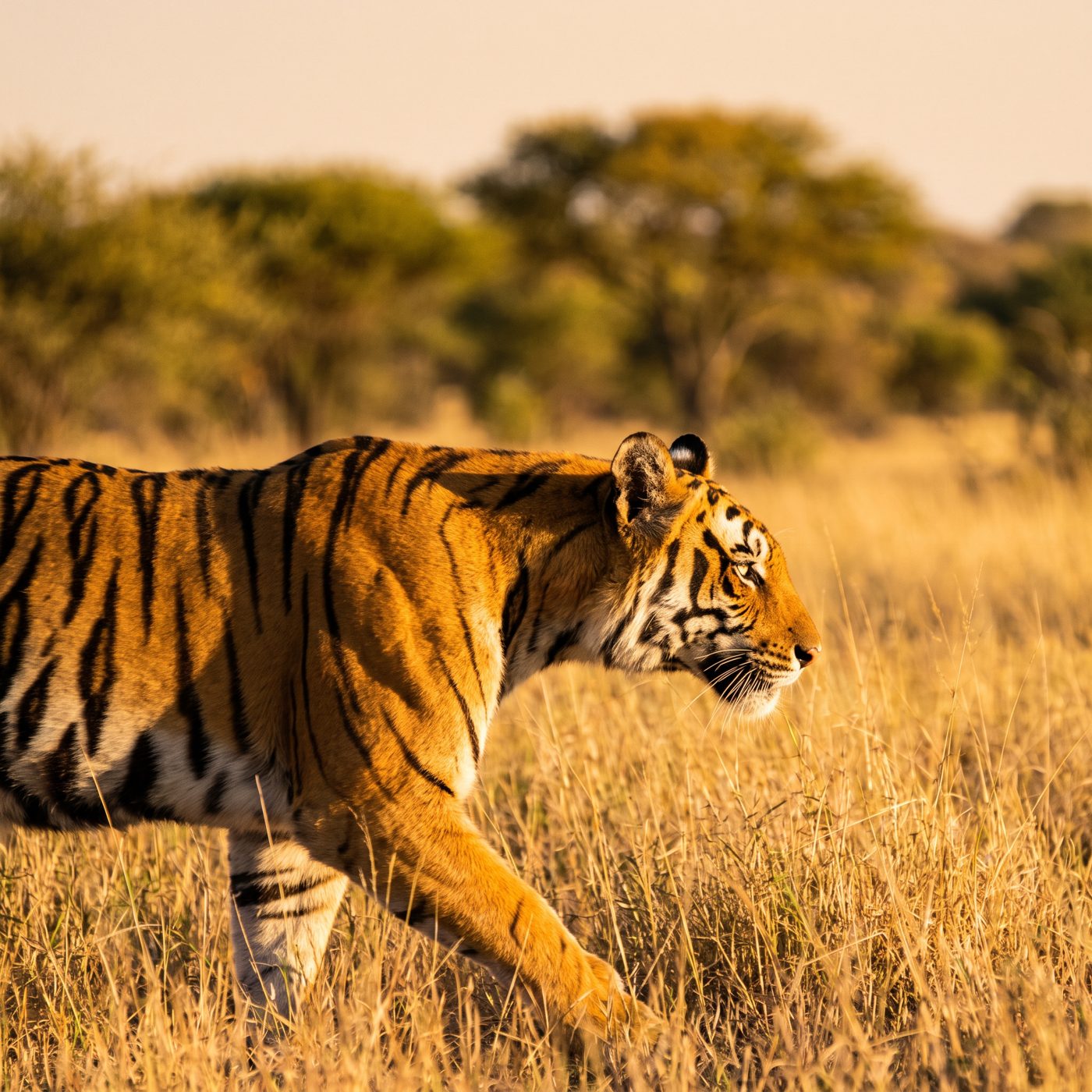 ILLUSTRATION · AI
A pattern-matching system built by Lex Hiby and colleagues correctly identified individual tigers 95% of the time on the first try — and every time within its top five guesses — across a database of 298 animals.
Every tiger wears a barcode. The dark stripes fanning across its flanks are as individual as a human fingerprint, and in 2009 a team led by Lex Hiby proved a computer could read them. Testing on a database of 298 individual tigers, their software returned the correct match as its top guess 95% of the time — and placed the right animal somewhere in its top five candidates in 100% of cases. It did this even when two photos of the same cat were shot from angles differing by as much as 66 degrees, or taken up to seven years apart.
That last figure matters more than it sounds. A tiger seven years older is heavier, older, photographed in different light, possibly limping. Its stripes, though, don't change. As the paper's title flatly puts it: a tiger cannot change its stripes.
How software matches a stripe pattern from any angle
The obvious problem is that a tiger is not flat. Photograph the same animal from the front and from the side and its stripes appear stretched, compressed, and curved differently — a naive pixel-by-pixel comparison falls apart immediately. Hiby, working with Phil Lovell, N. Patil, N. Samba Kumar, Arjun Gopalaswamy, and K. Ullas Karanth, solved this by fitting a three-dimensional surface model to each photograph. The software drapes a mathematical model of a tiger's flank over the image, then unwraps the stripe pattern onto a standard surface so two poses can be compared on equal footing.
The system is semi-automated, not magic. A human still marks reference points on each photo to anchor the 3D model before the matching runs. But once anchored, the comparison is objective and repeatable — the computer, not a tired field biologist squinting at a photo album, decides whether two cats are one cat.
The work appeared in *Biology Letters* in 2009. Their test database of 298 individuals came from real camera-trap and skin surveys — including, notably, photographs of tiger skins, which is why the paper's full title mentions matching "living tigers and tiger skins." A seized pelt can, in principle, be traced back to a specific living animal photographed in the wild.
Why matching individual tigers is a conservation problem
Counting tigers is genuinely hard, and getting it wrong has consequences. Governments and NGOs allocate protection money based on population estimates, and those estimates depend on knowing whether the tiger in last week's camera trap is the same one from last month or a different animal entirely. Karanth, one of India's foremost tiger biologists, had spent decades building rigorous camera-trap survey methods precisely because eyeball guesses don't hold up. Automated stripe-matching removes a bottleneck: a survey that captures thousands of images no longer needs an expert to hand-sort every one.
The 2009 results drew wide attention at the time — the science writer Ed Yong covered them, noting the 95% top-one rate and the seven-year, 66-degree robustness. More than a decade later, the numbers still get cited as a benchmark. A 2021 review in *Integrative and Comparative Biology* by Maxime Vidal and colleagues, surveying the whole field of individual-animal identification, held up Hiby et al.'s figures — 95% top-1, 100% top-5 on 298 individuals — as a landmark result bridging biology and computer vision.
The seam worth arguing over is what "identification" should mean now. Hiby's system still needs a human to place keypoints; today's deep-learning models promise fully automatic matching with no manual anchoring at all. Whether those newer systems actually beat 95% top-one accuracy on genuinely hard cases — grainy night shots, partial flanks, animals aged by years — remains an open contest. And there's a quieter question underneath: as identification gets easier, so does surveillance of the very animals we're trying to protect. A barcode readable by a friendly biologist is also readable by a poacher with a camera.
More facts

The internet's first message was 'lo' — on October 29, 1969 the receiving computer crashed after just two of the five letters sent.

The first message ever sent over the internet was 'LO' — the system crashed on October 29, 1969 as Charley Kline typed the 'G' in 'LOGIN.'