America's first motion picture, filmed in 1894, was copyrighted as a photograph — the law had no word for "movie" yet.
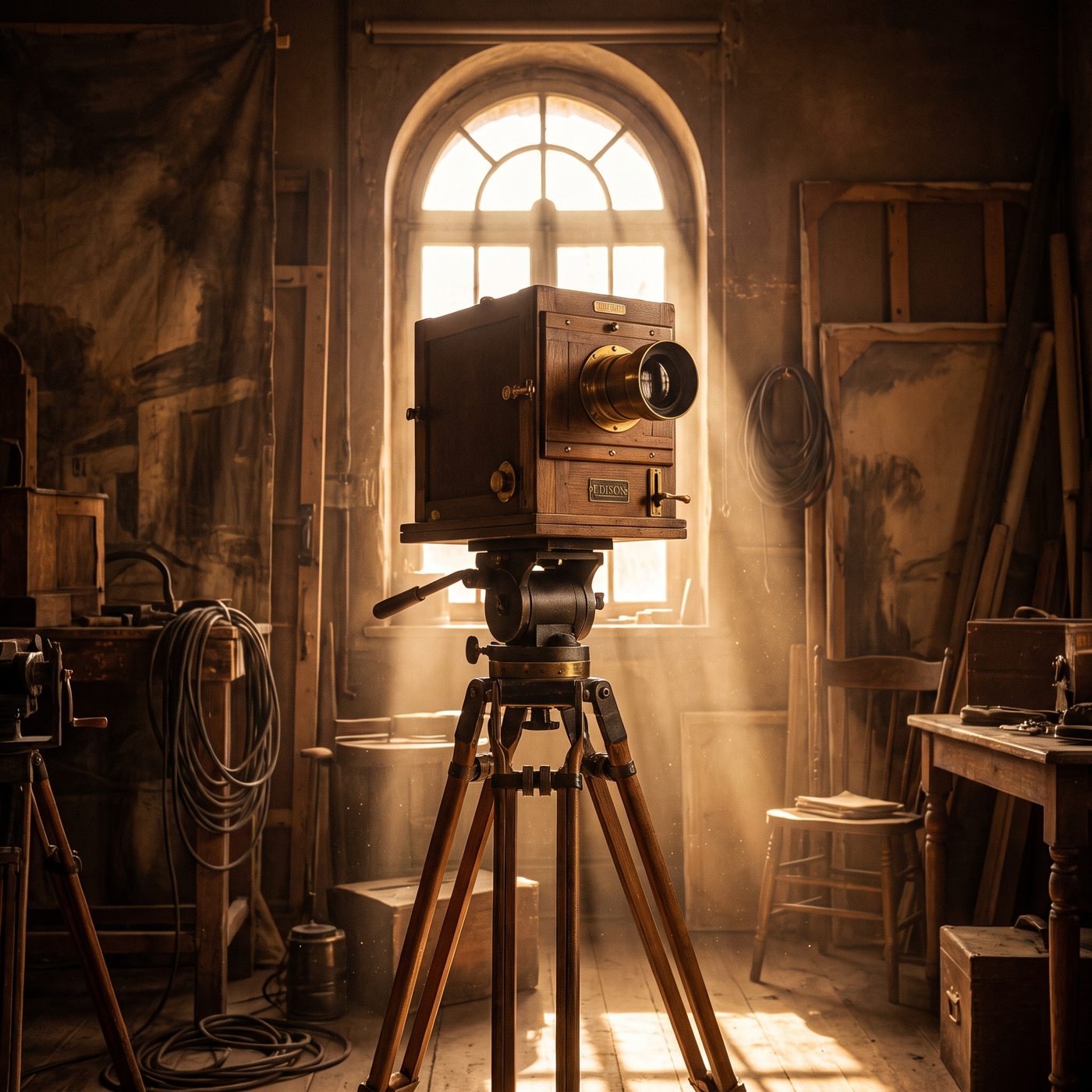 ILLUSTRATION · AI
America's first copyrighted motion picture was registered as a photograph in 1894 because U.S. copyright law had no category for film yet.
When the Edison laboratory sent a short film to the Copyright Office in early 1894, the clerk who received it faced a small legal problem: there was no such thing as a copyrighted motion picture. The law simply didn't recognize the format. So the office did the next best thing — it registered the film as a photograph. The Library of Congress records that the *Edison Kinetoscopic Record of a Sneeze* was received for copyright on January 9, 1894, and, in the absence of any better category, was entered as a photographic work.
The film itself is famous under a nickname it never officially carried: "Fred Ott's Sneeze." It runs only a few seconds. Fred Ott, a mechanic in Thomas Edison's West Orange laboratory, faces the camera, takes a pinch of something, and sneezes. That is the entire movie — one man, one sternutation, captured frame by frame on the Kinetoscope apparatus that W.K.L. Dickson had been building and refining for Edison.
Why the first movie was copyrighted as a photograph
The catalog record from the Library of Congress's Prints & Photographs Online Catalog states the situation almost word for word: "In 1894 there was no provision in the copyright law for the registration of motion picture film—the format still being in the process of invention and refinement—but, fortunately, the Copyright Office allowed the Kinetoscopic Record of a Sneeze to be registered as a photograph."
That phrase — "the format still being in the process of invention and refinement" — is the whole story in a clause. The technology was moving faster than the statute. The camera existed, the film existed, but the words to protect them legally did not. Congress would not pass the first copyright law specifically covering motion pictures until 1912, as the U.S. Capitol Visitor Center notes in its account of the Dickson registration. For nearly two decades, filmmakers who wanted legal protection had to file their work as photographs.
How the film survived: prints, not celluloid
Here is the vivid, concrete consequence of that legal workaround. Because the film was registered as a photograph, what Edison's people deposited with the government was not a strip of celluloid — it was paper. The Library of Congress, in its 1999 history "Early Motion Picture Productions," explains that the film was submitted as photographic prints: the individual frames printed out, one after another, on paper.
That accident of law turned out to be a preservation miracle. Early nitrate film stock decayed, caught fire, and vanished by the reel; countless movies from the medium's first decades are simply gone. But paper prints don't combust the way nitrate does, and they sat quietly in government files. Because so many early films were deposited this way to satisfy copyright, the Library of Congress ended up holding a paper record of motion pictures whose original celluloid had long since crumbled — frames that could later be re-photographed and reassembled back into moving images.
W.K.L. Dickson signed the registration as the man who "taken & copyrighted" it, and his name sits on the catalog record to this day. The sneeze that a mechanic performed for a colleague's camera became, by a bureaucratic shrug, the earliest surviving copyrighted motion picture in the United States.
What's left to argue about is the word "first." *Fred Ott's Sneeze* is the earliest film with a surviving copyright registration, and that is a documented fact you can check in the catalog. Whether it is the first American motion picture in any larger sense — the first shot, the first shown, the first to exist as film rather than as an idea — depends on how you define a movie in a year when the definition was still, in the Library's own phrase, in the process of being invented.
More facts
The internet's first message was 'lo' — on October 29, 1969 the receiving computer crashed after just two of the five letters sent.
The first message ever sent over the internet was 'LO' — the system crashed on October 29, 1969 as Charley Kline typed the 'G' in 'LOGIN.'